The “Secondary Damage” Trap: Identifying Forklift and Towing Damage in Auction Lots
The damage listed in an auction lot describes what happened to the car before it arrived at the yard. It doesn’t describe what happened after. Forklifts, winch cables, and J-hooks introduce their own set of problems, and auction yards don’t always disclose them.
Crushed rocker panels, bent control arms from improper towing, and punctured oil pans from misaligned forks are real costs that don’t show up in the original insurance claim. Buyers who budget based on the listed damage alone regularly find their projected margins erased on delivery.
In this post, we’ll show you exactly how to spot secondary yard damage in auction photos, which bank auction cars and insurance cars for sale are most at risk, and how to factor handling damage into your maximum bid before the timer runs out.
How Forklift Damage Occurs in the Yard
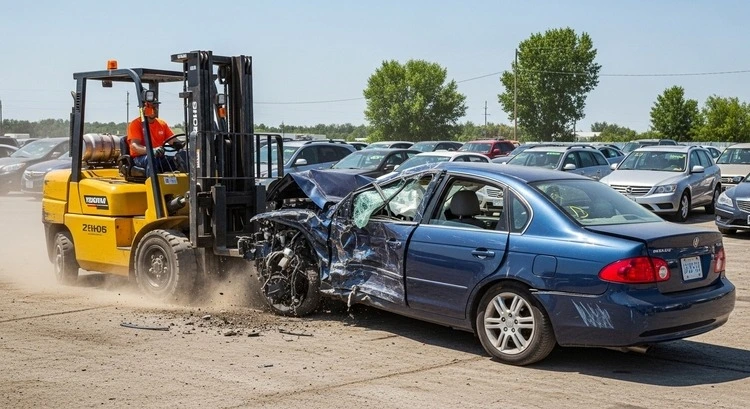
In major auction facilities, vehicles that are non-runners or have compromised suspension must be moved using massive forklifts. These machines slide their forks under the center of the chassis to lift and transport the unit to its assigned lot space. While operators are generally experienced, the sheer speed of yard operations means forks are sometimes placed improperly, putting thousands of pounds of pressure on the car’s weakest parts.
The most common victim of a forklift is the undercarriage. When the forks aren’t aligned with the subframe or designated lifting points, they can crush rocker panels, pinch fuel lines, or flatten exhaust systems. In 2026, as vehicles become lower and more aerodynamic, the margin for error during a forklift lift has shrunk. When searching for bank-repossessed cars, which are often runners, you might assume they avoided the forklift. Still, almost every car in an auction yard is moved at least once by heavy machinery during the check-in and out-processing phases.
Identifying Punctured Oil Pans and Fluid Leaks
One of the most catastrophic forms of secondary damage is a punctured oil pan or transmission housing. If a forklift fork strikes the underside of the engine, it can create a hairline fracture or a direct puncture. If the vehicle is then listed as “Run and Drive,” an unsuspecting buyer might attempt to start the engine once it is delivered, only to seize the motor because the oil has drained out on the auction lot.
When browsing bank auction cars, look closely at the “Undercarriage” or “Mechanical” photos if provided. Look for dark stains on the pavement beneath the car or “wet” areas on the bottom of the engine block. If you see a dent in the oil pan that wasn’t there in the original insurance claim photos (if available), you are likely looking at secondary yard damage. We recommend including a “startup fluid check” in your initial assessment process to ensure a handling mishap doesn’t turn into a total mechanical failure.
Suspension Stress and Bending from J-Hooks
Towing also introduces its own set of risks. When a vehicle is winched onto a flatbed or a tow truck, operators often use “J-hooks” or “T-hooks” to secure the vehicle to the winch cable. If these hooks are attached to a suspension control arm or a tie rod instead of a reinforced towing eye, the force of the winch can easily bend the component.
This type of damage is particularly deceptive because it is “hidden geometry.” A car might look perfect in a frontal photo, but if a tow operator bent a rear control arm while dragging the car out of a tight spot, the car will have permanent alignment issues. When you look at bank-repossessed cars for sale, check the wheel positions in the photos. If one wheel is “tucked” or angled differently than the others, don’t assume it happened during the repossession; it could very well be a result of improper towing at the auction yard.
Punctured Floor Pans and Rocker Panel Crushing
For many modern unibody vehicles, the rocker panels — the structural metal beneath the doors — are essential for the car’s rigidity. Forklifts that aren’t perfectly centered often crush these panels inward. In 2026, many manufacturers use plastic trim covers over the rockers, which can hide the structural crushing beneath.
To spot this, look at the bottom edge of the doors in the auction photos. If the door-to-body gap is uneven at the bottom, or if the plastic trim appears “buckled” or popped out of its clips, there is likely underlying forklift damage. While this is often labeled as “minor dents and scratches” by the yard, it can actually involve structural distortion that makes the vehicle difficult to align. We suggest budgeting for “undercarriage reconditioning” whenever you bid on a vehicle with a “Non-Runner” or “Stationary” status, as these are the units most frequently moved by forklifts.
The “Forklift Surcharge” for EVs and Hybrids
As we discussed in previous posts, electric and hybrid vehicles carry their batteries in the floor. This makes them exceptionally vulnerable to the “secondary damage” trap. A single misstep with a forklift can puncture a battery casing, turning a repairable EV into a total loss due to the risk of fire.
Because of this, many yards have implemented “EV Handling Protocols,” but accidents still happen. When bidding on electric bank auction cars for sale, look for any evidence of upward “bowing” in the floorboards from interior photos. If the carpet looks pushed up, or if the center console appears misaligned, the battery pack may have been struck from below. This is an immediate “walk-away” signal, as the safety risks and replacement costs of a punctured battery pack are insurmountable for most rebuilders.
Logistics and the “Post-Auction” Inspection
The best way to protect yourself from the “secondary damage” trap is to document the vehicle as soon as it leaves the yard. When we arrange shipping for your insurance cars for sale acquisitions, our carriers are encouraged to perform a “gate-check” inspection. If the carrier notices fresh undercarriage damage or a leaking pan that wasn’t in the auction description, this documentation is vital for any potential claims or disputes.
Having the vehicle towed directly to a shop with a lift is the final step. By getting the car in the air as soon as it arrives in Oklahoma or your home state, you can verify the integrity of the fuel and brake lines and the subframe before you begin the primary restoration. Catching a bent tie rod or a crushed exhaust pipe early allows you to fold these “secondary” repairs into your initial parts order, saving time and shipping costs.
Conclusion
The “secondary damage” trap is a reality of the high-volume auction environment. While yards do their best to manage thousands of vehicles, the industrial nature of the lot means that undercarriages and suspensions are often subjected to stresses they weren’t designed to handle. Success as a buyer in 2026 depends on your ability to “read” the photos for signs of yard abuse.
By looking for fluid stains, misaligned wheels, and buckled rocker panels, you can identify which “bargain” lots carry hidden handling costs. Treating every auction purchase as a “whole vehicle” evaluation, including the parts you can’t see from the beltline, ensures that your restoration remains profitable. With the right logistical support and a keen eye for undercarriage detail, you can navigate the “secondary damage” trap and keep your project on track.