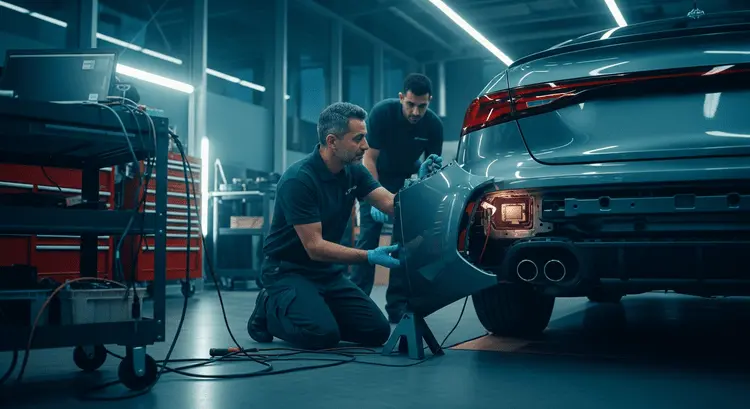
How Hidden Damage Wrecks Your Blind Spot Sensors
Over 840,000 U.S. crashes occur each year due to blind spots. In many of those cases, the driver’s blind-spot sensors were technically “on” but physically misaligned. When the hardware shifts even slightly, the entire warning system collapses without ever notifying you.
The NHTSA estimates car accidents cost Americans roughly $340 billion annually, and a big chunk of those collisions trace back to visibility problems. But here’s the part most people don’t realize: the plastics in your rear bumper cover are designed to flex and bounce back after low-speed hits. That means they can completely mask the structural misalignment of radar sensors mounted right behind them.
So your bumper looks perfect. Your paint isn’t scratched. And yet, your blind-spot monitoring system is feeding you bad data. Broken or misaligned visual aids and sensors create hazardous conditions quickly; in one case, broken blind-spot mirrors along a busy highway stretch caused nearly 10 accidents a day. A flawless paint job doesn’t guarantee a functioning safety system.
How Modern Blind Spot Monitoring Works
The market of Blind Spot Object Detection Systems is projected to reach $32.18 billion by 2036. That growth reflects the auto industry’s bet on Advanced Driver Assistance Systems (ADAS) to prevent highway fatalities.
And when they work? The numbers are impressive. The IIHS found that functioning blind spot monitoring reduces lane-change crashes by 14% and related injuries by 23%. If every vehicle had been equipped a decade ago, the technology would have prevented 50,000 crashes and 16,000 injuries. But those protective benefits depend entirely on the radar hardware’s physical durability. The moment impact damage shifts a sensor’s position, those stats stop applying to your vehicle.
Modern ADAS relies on tightly synchronized data from multiple cameras and radar units around the car’s perimeter. When hardware is physically disrupted, it creates a “Sensor Fusion Gap,” the point at which camera and radar data stop aligning because hardware has shifted by even a millimeter off its mounting axis. The system keeps operating as if nothing happened, delivering driving decisions based on a distorted picture of the lanes around you.
Diagnosing Hidden Damage Behind the Bumper
Radar sensors sit on rigid brackets attached to the quarter panel or rear body panel, tucked right behind your flexible bumper cover. A low-speed parking lot tap can easily bend those internal brackets without leaving a single scratch on the exterior. Sound unlikely? It happens constantly.
That’s why auto body professionals need to perform a specific R&R and R&I process, physically removing the bumper cover to access hidden brackets and check for sensor damage. Researchers recently developed a dual-point sensitivity model that shows how tiny mechanical imperfections can severely impact the synchronization of mechanisms. Automotive techs apply this same principle when measuring bracket deflection after a rear-end collision.
Drivers with misaligned brackets often experience unpredictable behavior from their safety systems. A wiring harness routing defect recently prompted a major repair bulletin for 2021-2025 full-size SUVs due to sensor proximity triggering system failures. Physical deviation alters the radar’s trajectory, which leads to a specific set of real-world problems you might recognize.
Here are common symptoms of misaligned blind spot sensors:
- False positive alerts when passing stationary objects like guardrails or signs
- Delayed warnings that only trigger after a passing vehicle is already in your side mirror
- Complete system shutdowns or dashboard error messages about limited assist functions
- Failure to detect smaller hazards like motorcycles or pedestrians
The Verification Gap
Here’s what makes this so dangerous. A verification gap happens when software processes operations and delivers incorrect results without warning the user. Your dashboard indicator light turns on normally, showing everything’s fine, while the underlying hardware is measuring the wrong physical space entirely.
This problem is especially serious in larger vehicles that already limit the driver’s natural line of sight. Pickup trucks have an average front blind spot of 11 feet, and even when fully calibrated, modern sensors can still miss motorcycles and pedestrians. Add mechanical misalignment on top of that, and a minor hardware defect becomes a lethal hazard.
Right-side blind spots alone account for 72% of all blind spot crashes across the United States. Manufacturers are fighting back with software; Tesla’s 2026.8 update, for instance, adds a “Blind Spot Warning While Parked” feature aimed at preventing dooring accidents with cyclists and pedestrians. But no software update can fix a physically bent bracket. If the sensor’s field of view is restricted by misalignment, even the most advanced patch is useless.
| Performance Metric | Calibrated Radar | Misaligned Radar |
|---|---|---|
| Detection range | Up to 150 feet | Reduced 30-50% depending on angle |
| Target acquisition speed | Instantaneous | Delayed up to 2 seconds |
| False positive rate | Near zero | High; triggers on stationary objects |
| Dashboard status | Normal (active) | Normal (doesn’t detect shift) |
Liability When Safety Hardware Fails
The consequences of a blind spot monitor failure go well beyond repair bills. Statistics show that 68% of blind-spot accidents occur during multi-lane highway lane changes. Medical professionals report whiplash injuries in 62% of those collisions. And when an at-fault driver tries to blame their vehicle’s safety hardware for a crash, the law still holds the driver responsible for visually verifying that clear lanes are present.
The legal landscape around ADAS failures is becoming more complex, especially as federal recalls of defective systems are becoming more common. A software glitch in the headlights recently forced Ford to recall 35,772 Explorer SUVs, highlighting the strict legal standards applied to vehicle safety mechanisms. Telaré Law, a personal injury firm with deep experience across Washington and Oregon, regularly handles collision cases involving technological failures and driver negligence. Their attorneys work to hold at-fault drivers accountable when reliance on broken safety technology causes preventable injuries.
At its core, watching out for blind spots is a human responsibility that no computer system can fully replace. Distracted driving, often exacerbated by misplaced confidence in malfunctioning tech, accounts for about 13% of all crashes nationwide. If you skip post-collision ADAS recalibration and cause a crash because of uncalibrated sensors, expect the victim’s legal counsel to pursue maximum damages. A documented failure to scan and recalibrate after a rear-end collision serves as powerful evidence of negligence in court.
Why Dealership-Level Scanning Is Non-Negotiable
Modern auto body shops use specialized OEM software to measure your radar’s pitch and yaw angles down to the degree. Dynamic ADAS recalibration means driving the vehicle at specific speeds on marked roads to align sensors with physical lane markers. Static recalibration, on the other hand, involves placing precisely measured targets around the stationary vehicle inside a controlled shop environment.
This type of diagnostic work is heavily software-driven, which makes it very different from a standard car door damage repair, which is mainly about metalwork, filler, and paint labor. Honda recently recalled over 65,000 vehicles for a software issue that left instrument panels and cameras blank, a reminder of how much modern vehicles depend on software diagnostics over basic mechanical repairs.
Technicians connect advanced diagnostic scanners to the OBD-II port to pull stored fault codes that don’t trigger visible dashboard warnings. This deep scan is the only reliable way to catch hidden sensor damage behind a bumper that looks perfectly fine. Skipping professional ADAS recalibration virtually guarantees reduced sensor performance and raises the risk of a secondary collision.
Post-Collision Diagnostics Are the New Standard
No visible cosmetic damage? That doesn’t mean your car is safe. Sensitive radar units are protected by flexible plastic bumpers, so even minor impacts can permanently warp the internal mounting brackets. That physical deflection throws off the accuracy of blind-spot monitoring and feeds false data to the driver.
Consider this: 1.7 million Ford and Lincoln SUVs were recently recalled to fix inverted backup camera images, proving that unverified safety systems pose a significant operational risk. Operating a vehicle with misaligned sensors puts everyone on the road in danger.
Always insist on a complete pre- and post-repair diagnostic scan after any bumper impact, no matter how minor. Verifying the exact pitch and yaw of internal radar sensors isn’t optional; it’s a safety requirement. The transportation sector keeps experiencing major malfunctions, such as the recent software upgrade that caused hundreds of thousands of smart meters to deliver incorrect readings. Your vehicle’s safety software is just as dependent on verified hardware. Taking the time to confirm sensor alignment makes sure your technology works as a real safeguard, not a hidden liability.