M70 With Tremec T56 BMW | The Ultimate V12 Manual Swap Guide
The automotive world is full of “what if” scenarios. What if BMW had built a dedicated manual supercar in the 90s? What if you could combine German precision with American durability? The answer lies in one specific, legendary modification: swapping the BMW M70 V12 engine with a Tremec T56 manual transmission.
For decades, the BMW M70 engine has been revered for its smoothness. It powered the flagship 7 Series and the stunning 8 Series coupes. However, most of these cars left the factory with 4-speed automatic transmissions. While comfortable, these old automatics rob the V12 of its true character, feeling sluggish and disconnected. This is why the M70 with Tremec T56 BMW swap has become a holy grail for enthusiasts. It wakes up the engine, transforming a quiet luxury cruiser into a roaring, driver-focused machine.
The Power Couple: M70 Engine and Tremec T56
Successful engine swaps are all about chemistry. You need an engine that produces power and a transmission that can handle it without breaking. In this build, we are pairing two of the best components from their respective continents.
BMW M70 V12: The Foundation
The BMW M70B50 was a milestone in automotive history. Launched in the late 1980s, it was Germany’s first post-war V12 engine. It isn’t a screaming race engine; it is a torque monster. With 5.0 liters of displacement, it puts out around 300 horsepower and, more importantly, about 330 lb-ft of torque.
This engine is famous for its “turbine-like” delivery. It pulls hard from low RPMs and stays smooth all the way to the redline. Using dual ECUs and dual Mass Air Flow (MAF) sensors, it essentially runs as two inline-6 engines joined at the crank. It is reliable, over-engineered, and incredibly smooth.
Tremec T56: The Workhorse
If the M70 is the sophisticated heart, the Tremec T56 is the iron fist. This 6-speed manual gearbox is arguably the most famous manual transmission in the world. Originally, it was built for high-performance American cars like the Dodge Viper, Chevrolet Camaro, and the Pontiac Firebird.
The T56 brings a raw, mechanical feel that modern cars lack. It connects you to the road in a way that feels nostalgic yet powerful. It carries the same rebellious spirit found in the iconic Smokey and the Bandit Firebird, bridging the gap between classic muscle heritage and modern reliability. It is designed to take a beating and keep asking for more.
Why Pair the M70 With the Tremec T56?
You might wonder why builders choose the American T56 over a BMW manual gearbox. The answer comes down to availability, strength, and driving dynamics.
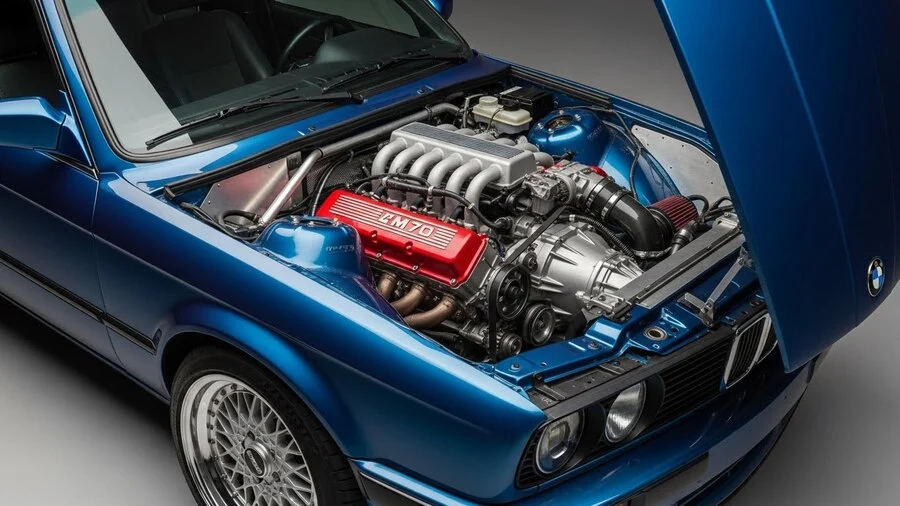
Enhanced Driver Engagement
The stock automatic transmission in an old BMW 850i acts like a filter. It numbs the sensation of speed. When you swap in a T56, you remove that filter. You get direct control over the V12, deciding exactly when to shift.
This setup allows you to hold gears longer and hear the engine sing. Throttle response feels immediate because there is no torque converter soaking up the energy. Suddenly, a grand tourer feels like a nimble sports car.
Superior Torque Handling & Reliability
BMW did make a manual V12 (the 850CSi), but those transmissions are incredibly rare and expensive to fix. The Tremec T56, on the other hand, is everywhere. More importantly, it is strong.
Rated to handle over 450 lb-ft of torque in its standard form, the T56 is well within its safety zone when paired with the M70’s 330 lb-ft output. You can drive it hard, launch it at stoplights, and enjoy the car without constantly worrying about shattering the gears.
Optimized Gear Ratios for Grand Touring
One of the best features of the T56 is its 6th gear. This is a “double overdrive” gear. It significantly drops your engine RPMs when you are cruising on the highway.
The M70 is a thirsty engine. By using the T56, you can cruise at high speeds with the engine barely ticking over. This improves fuel economy compared to the original 4-speed automatic, making the car much more usable for long road trips.
The Technical Swap Guide: What You Need
Swapping a transmission isn’t as simple as unbolting the old one and sliding the new one in. Since the BMW M70 and the Tremec T56 were never neighbors on the assembly line, they don’t fit together naturally. To make them work as a cohesive unit, you need specific custom parts and a bit of fabrication work. This is where the project moves from a simple “bolt-on” repair to a true “custom build.”
Adapters and Bellhousing
The biggest hurdle is the physical connection. The bolt pattern on the back of the BMW V12 does not match the front of the Tremec transmission, so you cannot simply bolt them together.
To solve this, you need a high-quality adapter plate. This thick metal plate sits between the engine and the transmission, acting as a bridge between the German and American bolt patterns. While some advanced builds might use a custom-machined bellhousing, using an adapter plate is generally the most common and cost-effective route for this specific swap.
Flywheel and Clutch Solutions
Once the cases are bolted together, transferring the power becomes the next challenge. The stock BMW automatic uses a flexplate and a torque converter, which must be removed entirely.
In their place, you will install a custom flywheel. Many builders opt for a single-mass flywheel rather than the heavy stock dual-mass unit. A lighter flywheel allows the big V12 to rev up faster, making the car feel more responsive. You will also need a custom clutch kit that matches the splines on the T56 input shaft but fits the BMW flywheel surface.
Driveline and Mounting Modifications
The T56 is physically different in size and shape compared to the original ZF automatic. This leads to three main fabrication tasks:
- Transmission Mounts: You will likely need to fabricate a custom crossmember to hold the tail of the transmission at the correct angle.
- Driveshaft: The stock driveshaft will be the wrong length. You must measure the distance exactly and have a shop shorten or lengthen your driveshaft to fit.
- Pedals: You need to add a clutch pedal to the driver’s footwell. Sourcing a manual pedal box for a BMW E31 (8 Series) or E32 (7 Series) can be difficult, as they are rare parts.
Cost Breakdown: Is It Worth the Investment?
This is not a budget-friendly project. It is an investment in the car’s future value and your driving enjoyment. You should be prepared for the financial reality before you turn the first wrench.
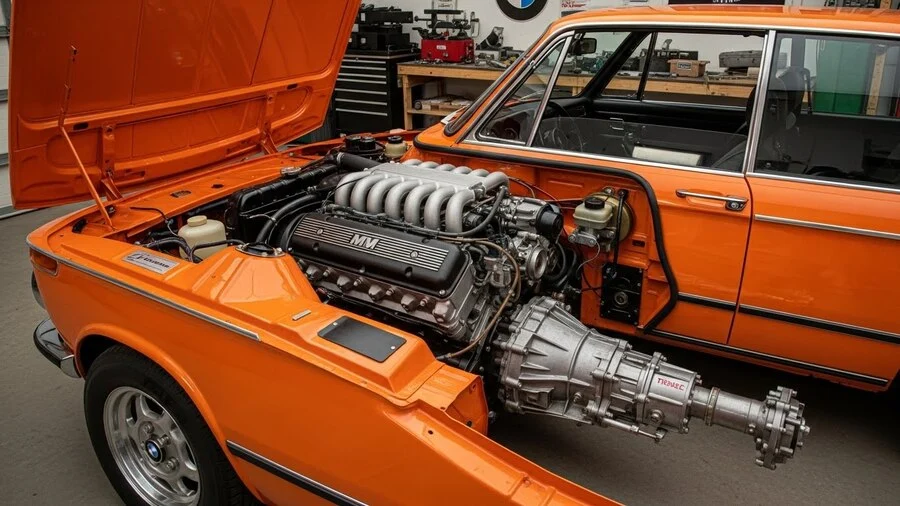
A used Tremec T56 generally costs between $2,500 and $4,000, depending on its condition. The adapter kit, which includes the plate and necessary hardware, will run another $800 to $1,200. Then you have the clutch and flywheel setup, which can easily cost $1,500 for high-performance parts.
When you add in the custom driveshaft work, hydraulic lines, and the inevitable small parts, the parts bill alone often sits between $6,000 and $8,000. If you are paying a shop for labor, expect the total project cost to range from $9,000 to over $12,000.
Performance Gains and Daily Drivability
The cost is high, but the result is transformative. The first thing you notice is the weight. The manual gearbox is generally lighter than the old automatic unit, which improves the car’s weight distribution.
On the road, the difference is night and day. Shift times drop from the lazy slur of an automatic to as fast as your hand can move—usually around 0.3 seconds. The car feels lighter on its feet. Engine braking becomes a useful tool for cornering, giving you confidence on twisty roads that the automatic never provided.
Beyond the Mechanics: Aesthetics and Legalities
Once the mechanical work is done, many owners feel the need to refresh the car’s exterior to match its new, aggressive personality. A “restomod” like this often gets a full visual restoration.
However, before you commit to a radical new look, you need to be careful. Modifying a classic car involves legal responsibilities. If you decide to repaint your vehicle to signal its new performance status, ensure you aren’t violating any regulations. For instance, specific color schemes reserved for emergency vehicles are off-limits. It is crucial to know what color is illegal to use on cars in your area to avoid fines or registration headaches after you’ve already spent thousands on the build.
Pros and Cons Summary
Here is a quick look at the trade-offs involved in this swap.
Pros:
- Unmatched Feel: A V12 with a manual stick is a rare, visceral experience.
- Reliability: The T56 is bulletproof compared to vintage electronics.
- Value: Manual-swapped V12 BMWs often command a premium in the enthusiast market.
Cons:
- High Cost: It is significantly more expensive than just repairing the automatic.
- Fabrication: It requires cutting, measuring, and custom parts.
- Complexity: This is not a beginner’s weekend project.
Conclusion
The M70 with Tremec T56 BMW swap is the ultimate expression of what these cars were meant to be. It liberates the V12 engine from the shackles of 1980s automatic technology. While the road to completion is paved with custom fabrication and high costs, the destination is worth it. You end up with a car that combines the velvet smoothness of a German flagship with the tactile, mechanical engagement of a true sports car. For the serious driver, there is no better upgrade.