What Color Is Illegal to Use on Cars? | A Complete Legal Guide
You might think your car is a blank canvas waiting for your creative touch. We see cars every day in every shade imaginable, from matte black to pearlescent pink. But before you book an appointment for that custom paint job or order a roll of vinyl wrap, you need to hit the brakes. Not every color is fair game.
The reality is that vehicle aesthetics are not just about personal style; they are a matter of public safety. Driving a vehicle with a prohibited color scheme can lead to more than just a fix-it ticket. You could face steep fines, vehicle impoundment, or even criminal charges for impersonation. In the United States, traffic laws vary by state, but the core rules remain consistent: your car must not confuse other drivers or hide from the law.
Why Are Certain Car Colors and Finishes Prohibited?
Governments and transportation departments, such as the DMV, enforce strict rules on vehicle appearance for two main reasons: Identification and Safety.
First, road users must be able to instantly recognize emergency responders. When a police officer or an ambulance driver needs to get through traffic, seconds count. If civilians drive cars that look identical to these emergency vehicles, it creates dangerous confusion. Drivers might brake suddenly for a fake police car, causing rear-end collisions. Conversely, if “fake” emergency cars become common, drivers might ignore a real ambulance, delaying critical medical help.
Second, certain finishes are physically hazardous. A car isn’t just an object to be looked at; it is a moving part of a complex traffic system. If your paint absorbs all light (making the car invisible at night) or reflects too much sunlight (blinding other drivers), you become a rolling road hazard.
The “Impersonator” Bans: Restricted Colors and Liveries
The most common legal issue involves “impersonation.” You generally cannot paint your vehicle in a way that mimics a government official or law enforcement agency.
Law Enforcement Blue and Emergency Red
In almost every US state, specific combinations of blue and red are legally restricted. While you can own a blue car or a red car, you cross the line when you combine them in patterns used by the police. For example, painting your doors white while keeping the hood and trunk black—often called the “Panda” scheme—is perfectly legal on its own. However, if you add a shield decal on the door or a light bar on the roof, you are breaking the law.
Lighting plays a huge role here as well. It is illegal to have forward-facing red or blue lights on a civilian car. This restriction extends to the inside of the cabin. If you modify your vehicle to have cars with red interior lighting that is visible through the windshield, other drivers might mistake your dashboard glow for an undercover police cruiser’s flashing lights. This creates panic and unpredictable driving behaviors around you.
The Prohibition of Yellow on Defense and Civilian Vehicles
Yellow is the universal color of caution. We see it on school buses, road signs, and construction equipment. Because of this, some jurisdictions restrict specific high-visibility yellow shades.
Historically, “Defense Yellow” or similar high-vis hues are reserved for vehicles that need to stand out for safety, such as fire trucks (which are increasingly yellow/green) and airport defense vehicles. If your private car is painted this specific safety shade, you might be cited for creating confusion, as other drivers may assume you are part of a road crew or emergency response team and drive erratically to give you space you don’t legally have.
White Striped, Symbolized, and Official Decals
A plain white car is the most common vehicle on the road and is 100% legal. The problem starts when you add graphics. You cannot place the word “POLICE,” “SHERIFF,” or “STATE TROOPER” on your car, even as a joke.
This restriction often covers symbols, too. A white car with a generic gold star on the door or reflective striping running down the sides can be deemed illegal. Even if you don’t use the word “Police,” if a reasonable person would mistake your car for a patrol unit at a quick glance, you are likely violating laws regarding the usurpation of office.
Hazardous Aesthetics: Neon, Chrome, and Reflective Finishes
While impersonating a police officer is a clear legal violation, other restrictions are based on physics. Some cars finishes manipulate light in ways that make the roads dangerous for everyone else. If your car becomes a visual distraction or an optical hazard, authorities have the right to intervene.
The Dangers of Chrome and Mirror Wraps
Chrome wraps have exploded in popularity due to their futuristic, high-end look. However, wrapping your entire vehicle in “Mirror Gold” or “Silver Chrome” treads a fine line between style and illegality.
The primary issue is “dazzle.” In bright sunlight or under the beams of oncoming traffic at night, a fully reflective car acts like a mirror. It can reflect blinding light directly into the eyes of other drivers, causing temporary blindness. In countries like Australia and specific U.S. states like California, police can issue a defect notice if they determine your vehicle causes excessive glare. While not always explicitly banned by name, these wraps often violate general “unsafe vehicle condition” laws.
Neon and Fluorescent Paints
Bright colors are generally legal; you can buy a “highlighter yellow” sports car from the factory. However, aftermarket neon paints and fluorescent finishes that glow intensely can be problematic.
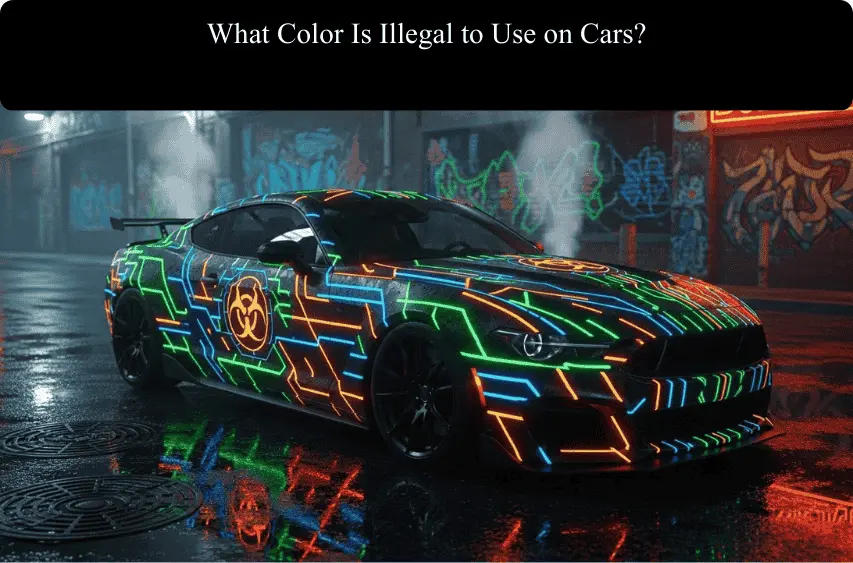
The legal test here is usually distraction. If your paint job is so jarring that it causes other drivers to rubberneck or lose focus, you may be pulled over. This is strictly enforced when combined with underglow lighting. In most states, driving with neon lights activated on public roads—especially blue or red—is prohibited.
Vantablack and Light-Absorbing Paints
On the other end of the spectrum is Vantablack (and similar commercial alternatives like Musou Black). These paints are engineered to absorb up to 99.9% of visible light, effectively erasing the car’s 3D features and making it look like a two-dimensional void.
While there is no federal law explicitly named “The Vantablack Ban,” driving such a vehicle at night is incredibly dangerous. Without light reflection, other drivers cannot gauge your vehicle’s speed, distance, or shape. If your “invisible” car is involved in a collision, you could be held liable for negligence because you intentionally removed the visual cues that keep traffic safe.
Blacked-Out Windows and Tinted Lights
The “murdered-out” look—black paint, black wheels, and black windows—is a favorite among customizers. However, this is where many drivers unintentionally break the law.
- Window Tint: Every state has a legal limit on “Visible Light Transmission” (VLT). For example, your front side windows might need to let in at least 35% or 50% of light. Windshields are usually off-limits except for a top strip.
- Smoked Lights: Spraying your taillights with black tint to match the bodywork is illegal in most jurisdictions. Federal safety standards require brake lights to be visible from a specific distance (often 500 to 1,000 feet). If your tint reduces this visibility, your car is not road-legal.
The Role of Car Wraps and Custom Paint Jobs
Technological advancements have made changing your car’s color easier than ever. You no longer need to sand down your car to get a new look; you can simply apply a vinyl sticker. But does the law treat a sticker differently from paint?

Are Car Wraps Subject to the Same Laws as Paint?
Yes. The law cares about the appearance of the vehicle, not the material covering it. A chrome wrap is just as illegal as chrome plating if it blinds other drivers. A police-style livery on vinyl is just as illegal as one painted on.
Furthermore, if you wrap your car, you are legally changing its color. If your registration says “White” and you wrap it “Matte Green,” your vehicle description no longer matches official records. If police run your plate and see a discrepancy, they have probable cause to pull you over.
The “Harlequin” Rule: Multi-Colored Panels
What if your car isn’t just one color? The “Harlequin” style—made famous by Volkswagen in the 90s—features panels of different colors (e.g., a red door, yellow hood, blue fender).
This is generally legal, provided you haven’t accidentally recreated a protected pattern (like a police car). It is also common for drivers repairing older vehicles to use junkyard parts in mismatched colors. In these cases, the “primary” color listed on your registration should usually be the color of the permanent chassis or the largest surface area (like the roof and rear quarters).
Cost and Considerations for Legal Repainting
If you decide to modify your vehicle’s color permanently, you must consider the financial and legal commitment. A professional paint job is an investment. Before you pay, ask yourself: “Is this color street legal?”
Fixing a mistake is expensive. If you paint your car a restricted color and are ordered to change it, you will pay twice. Understanding how much does it cost to paint a car beforehand helps you budget for a compliant, high-quality finish that won’t get you ticketed. A cheap “quick spray” often looks bad and degrades quickly, while a proper legal color change involves door jams, engine bays, and updating your paperwork.
Here is Part 3, the final section of the comprehensive guide.
Jurisdiction-Specific Color Laws
Car modification laws change the moment you cross a border. What is permissible in Florida might be illegal in California or overseas. It is crucial to understand the rules specific to where you drive.
United States and United Kingdom
In both the US and the UK, the primary focus is on preventing police impersonation. In the UK, driving a car with “Battenburg” markings (the blue and yellow checkered pattern) is a criminal offense for civilians. Similarly, in the US, while you can own a black and white car, many states prohibit marking it with shields or emblems that even remotely resemble official insignia.
Germany (StVZO Regulations)
Germany has very specific road traffic licensing regulations, known as StVZO. For years, German police cars were green and white. Today, they are blue and silver. Because of this shift, driving a vintage green and white car is legally complex. While you might get a pass for a classic car (Oldtimer), strict laws ban reflective strips on private vehicles. Parody stickers like “POZILEI” are often tolerated but can still lead to fines if a judge decides they were intended to deceive other drivers.
Australia (NCOP Guidelines)
Australia enforces the National Code of Practice (NCOP). This code specifically addresses “dazzling” finishes. If you apply a full chrome wrap in Queensland or New South Wales, you will likely be defected. The authorities there take glare very seriously, and any modification that reflects excessive light is deemed unroadworthy.
Legal Obligations: Registration and Penalties
Modifying your car is not just a physical process; it is a bureaucratic one. Your vehicle’s registration is a legal identity document, and it must match reality.
Updating Your Vehicle Registration
If you change your car’s color—whether by paint or a long-term wrap—you are legally required to notify your local vehicle authority (DMV, DVLA, etc.). Identification is the main reason for this. If your car is stolen, police need to know what to look for. If your registration says “Silver” but your car is now “Matte Black,” recovery becomes much harder, and you may face fines for failing to update your records.
Fines, Impoundment, and Insurance Issues
The consequences of non-compliance can be steep. A police officer can issue a “fix-it” ticket, requiring you to remove the wrap or repaint the car within a set timeframe. In severe cases, such as impersonating an officer or driving a vehicle deemed a hazard (like a Vantablack car at night), your vehicle can be impounded on the spot. Furthermore, if an illegal modification contributes to an accident—for instance, if your chrome wrap blinds another driver—your insurance company may deny your claim, leaving you personally liable for damages.
How to Check if a Color Is Legal in Your Area
Don’t rely on rumors or social media. To be safe, go to the source.
Consulting Local Authorities and Government Websites
Visit your local DMV or transport department website. Search for “vehicle modification standards” or “prohibited vehicle colors.” Most government sites list exactly what lighting and marking combinations are banned.
Verifying with Professional Auto Shops and Painters
Reputable auto body shops and wrap installers know the law because their business depends on it. If you ask for a full chrome wrap or police-style decals, a professional shop will likely warn you about the legal risks or refuse the job entirely.
Conclusion
Your car is an extension of your personality, but the road is a shared space. While regulations on colors and wraps might feel restrictive, they exist to keep traffic flowing safely and to ensure emergency responders can do their jobs without interference. By avoiding restricted emergency colors, steering clear of hazardous reflective or light-absorbing finishes, and keeping your registration updated, you can enjoy your custom ride without the fear of flashing blue lights in your rearview mirror.
FAQs
Technically, no specific law names “Vantablack” as illegal yet. However, driving a car that absorbs almost all light is extremely dangerous and likely violates general road safety clauses regarding visibility. You would likely be stopped for driving an unsafe vehicle.
Statistically, black cars are involved in more accidents than any other color. This isn’t because the color is illegal, but because black vehicles are harder to see at dawn, dusk, and night compared to white or yellow cars.
Standard gold or silver metallic paint is perfectly legal. The issue arises with chrome wraps that act like mirrors. If the finish reflects a distinct image rather than just scattering light, it may be classified as a distraction hazard.
Yes, in most jurisdictions. Even though a wrap is temporary, if it stays on the car for a significant period and changes the vehicle’s primary appearance, you must update your registration to match the new color.