Smokey and the Bandit Firebird: The Ultimate Guide to the Black and Gold Icon
The 1977 Pontiac Firebird Trans Am is not just a car; it is a full-blown Hollywood celebrity. When Smokey and the Bandit hit theaters, it didn’t just launch Burt Reynolds into a new stratosphere of fame—it dragged the entire Pontiac brand along with him. Before this movie, the American muscle car era was gasping for air. High insurance premiums and strict emissions laws were choking the life out of V8 performance. Then came the Bandit.
This black and gold machine became the defiant symbol of the late 1970s. It wasn’t just a prop used to get characters from point A to point B. It was a co-star. The script relied on the car’s ability to drift, jump, and outrun the law, creating a dynamic that audiences loved. While modern car ownership often revolves around computerized schedules and precise maintenance like a Mercedes A3 service, the relationship between the Bandit and his Trans Am was raw, mechanical, and abusive. It captured a moment in time when horsepower mattered more than safety ratings, and looking cool was the only rule that really counted.
The Machine: Specifications of the 1977 Trans Am Special Edition
To understand why this car is so special, you have to look past the movie magic and under the hood. The vehicle that appeared on screen was the Trans Am Special Edition, specifically the Y82 package. This specific configuration is what every collector chases today.
The Y82 Special Edition Package
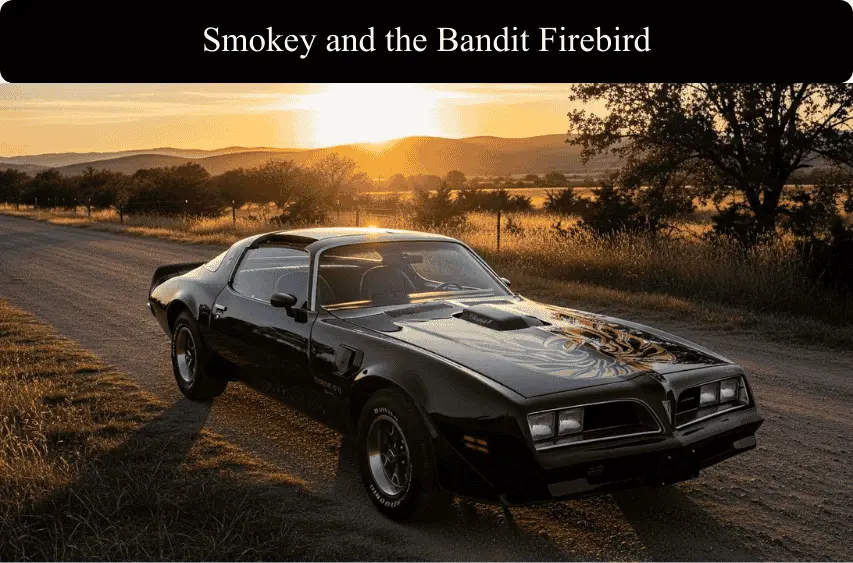
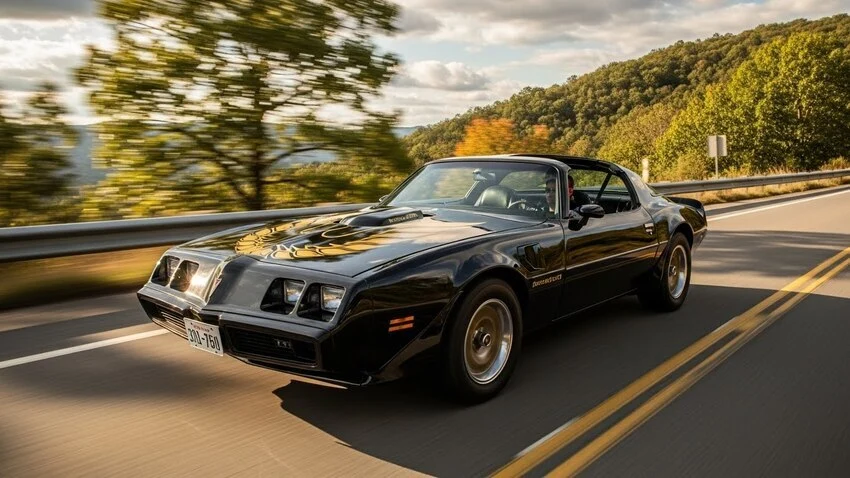
The Y82 package is what gave the car its signature menace. Designed by John Schinella, this livery featured a stark black exterior accented with gold pinstriping that highlighted the car’s aggressive lines. But the centerpiece was the hood. The “Screaming Chicken” decal, officially known as the hood bird, was a bold design choice that became an icon.
In 1977, this look was an option. You could order the car with a Hurst T-Top roof or a standard hardtop. The movie car famously featured the T-Tops, which allowed for better camera angles and let the actors’ faces be seen during driving shots. This open-air look became a “must-have” for buyers walking into dealerships the following year.
Under the Hood: Pontiac 400 vs. Oldsmobile 403
If you pop the hood of a 1977 Trans Am, you might find one of two very different engines. This distinction matters to collectors and mechanics alike. The “real” Pontiac engine was the 6.6-liter (400 cubic inch) V8. This engine came in two flavors: the standard L78, which produced about 180 horsepower, and the more desirable W72 performance package, which bumped that number up to 200 horsepower.
However, not all Trans Ams were created equal. Due to stricter emissions regulations in California and high-altitude areas, General Motors couldn’t sell the Pontiac 400 there. Instead, they dropped in an Oldsmobile 403 cubic inch V8.
You can spot the difference without even opening the hood. The shaker hood scoop on the Pontiac-powered cars displayed a “T/A 6.6” decal. The Oldsmobile-powered cars simply said “6.6 Litre.” It was a simple time for mechanics. They didn’t need to scan for a complex 7ea engine code to figure out why the car was sluggish; they just checked the vacuum lines and the carburetor.
Behind the Scenes: Production Secrets and The “Frankenstein” Cars
What you see on the screen is rarely the truth in Hollywood. The production of Smokey and the Bandit is famous for its chaotic schedule and creative problem-solving. One of the biggest secrets involves the actual model year of the cars used.
The 1976 vs. 1977 Model Year Mix-Up
Filming began in 1976, months before the 1977 Trans Am was available for sale. Director Hal Needham needed the cars immediately, but General Motors couldn’t supply the new models yet. They struck a compromise. GM sent four 1976 Trans Ams to the set.
To make them look like the upcoming model, the production crew performed a facelift. They removed the 1976 front ends, which featured single round headlights and a flatter bumper. In their place, they installed the aggressive 1977 “batman” nose, which featured rectangular quad headlights and a slanted V-shape. They also swapped the hood scoops and updated the decals. To the average viewer, these were brand-new 1977 cars. In reality, they were “Frankenstein” vehicles built to deceive the camera.
Movie Magic: Sound Dubbing and Speedometer Tricks
The deception didn’t stop at the bodywork. If you listen closely to the movie, the Trans Am sounds incredibly aggressive—almost like a race car. That’s because it is one, but it’s not a Pontiac. The sound editors felt the stock Pontiac V8 was too quiet for a legendary outlaw. To fix this, they dubbed over the engine noise using audio recordings from a 1955 Chevrolet 150 Custom race car. This same audio track was used in the classic film Two-Lane Blacktop.
Visual tricks were also used to make the car look faster. In several scenes, the speedometer is shown pinning the needle. However, the car wasn’t actually traveling at those dangerous speeds. The crew used a speedometer calibrated in Kilometers per Hour (km/h) rather than Miles per Hour (mph). When the needle hit 110, the car was actually doing about 68 mph. This allowed them to film “high speed” shots safely while making the Bandit look fearless.
How Many Firebirds Were Used in Smokey and the Bandit?
It is a common misconception among casual fans that the movie relied on a single, indestructible car to handle every scene. In reality, film production requires redundancy to prevent delays. If the hero car breaks down without a backup, the entire shooting schedule grinds to a halt, costing the studio thousands of dollars per hour. To avoid this nightmare scenario, Pontiac supplied the production team with a small fleet of vehicles, each assigned a specific role based on the danger level of the scenes involved.
The Four Primary Movie Cars
Pontiac provided director Hal Needham with four specific Trans Ams, and each had a clearly defined lifespan. The first car was the “Close-Up” vehicle. This unit was treated with extreme care. It was used strictly for scenes where the camera focused on Burt Reynolds and Sally Field talking inside the cabin, ensuring that the paint and interior looked showroom perfect in every shot.
The second and third cars were the workhorses of the production. One was designated for general action—drifting around corners, kicking up dust on dirt roads, and dodging traffic. The other was the dedicated “Jumper.” This car had a short, violent life. It was rigged specifically for the famous bridge jump scene and was completely totaled the moment it hit the ground. The fourth car was a “Promotional” vehicle intended for marketing tours after filming. However, the production was so rough on the other cars that this pristine promotional vehicle was eventually drafted into service. By the time they shot the final scene, the cars were in such bad shape that the one used in the closing shot wouldn’t even start—the crew had to push it into the frame.
Mechanical Struggles on Set
Maintaining these cars during a grueling shoot was a constant battle. The stunt team didn’t have the luxury of ordering parts and waiting a week for delivery. They were filming in remote locations, often pushing the cars beyond their mechanical limits day after day.
When a suspension arm snapped or a radiator cracked during a chase scene, the mechanics had to improvise immediately. They often cannibalized parts from the already-wrecked stunt cars to keep the remaining vehicles moving. It was a gritty, hands-on effort to keep the production schedule on track, proving that the smooth performance seen on screen was built on sweat, quick fixes, and mechanical ingenuity behind the camera.
The Stunts That Defined the Legend
In the era before computer-generated imagery (CGI), every stunt had to be performed practically. This meant real cars, real drivers, and real physics. The visceral appeal of Smokey and the Bandit comes from this authenticity; when you see the car sliding through the mud or launching into the air, you know metal is actually bending, and tires are actually smoking.
The Mulberry Bridge Jump
The defining moment of the film is arguably the jump over the dismantled Mulberry Bridge. This was a practical stunt performed by a driver who risked his life to get the shot. To ensure the car cleared the river, the crew fitted the Trans Am with a booster rocket.
The car launched perfectly, soaring through the air and landing on the other side. However, the landing was brutal. The impact instantly destroyed the suspension and twisted the frame of the car. While it looked triumphant on film, that specific Trans Am never drove again. It was a one-take wonder that cemented the car’s reputation for invincibility.
The Police Chase and The LeMans Enforcer
The Bandit needed a worthy adversary, and he found it in Sheriff Buford T. Justice. The Sheriff drove a 1977 Pontiac LeMans, but this wasn’t just a standard family sedan. Pontiac offered a “Freeway Enforcer” package specifically for law enforcement agencies.
These police cruisers were built to take a beating. They featured heavy-duty brakes, upgraded suspension springs, and better cooling systems to handle high-speed pursuits. While the movie portrays the LeMans as a hapless victim of the Bandit’s tricks—losing its roof, door, and eventually its dignity—the car itself was a capable machine. In many ways, the durability of the LeMans in the film is just as impressive as the agility of the Trans Am.
The “Bandit Effect”: Economic Impact on Pontiac
Hollywood has always influenced trends, but rarely has a single movie shifted the economics of an entire industry so drastically. The release of Smokey and the Bandit transformed the Trans Am from a niche enthusiast vehicle into a mainstream cultural phenomenon.
Sales Explosion and Record Years
Before May 1977, the Firebird was performing adequately, but it was not a sales leader. After the movie premiered, dealerships were overwhelmed. The sales numbers tell the story best. In 1977, Pontiac sold roughly 68,000 Trans Ams. By 1979, just two years after the film’s release, that number skyrocketed to over 117,000 units. The “Bandit” look became the uniform of the late 70s. It wasn’t just car enthusiasts buying them; it was regular people who wanted to capture a piece of the rebellious magic they saw in the theater.
Delaying the Third-Generation Firebird
This success actually caused a significant shift in General Motors’ production planning. The engineering team had been preparing to release a completely redesigned Firebird (the Third Generation) around 1980. However, the “Bandit” body style was selling so well that executives decided to delay the new model.
Why change a winning formula? They pushed the redesign back to 1982, squeezing every last drop of profit out of the Second Generation platform. The movie didn’t just sell cars; it effectively extended the lifespan of an entire automotive design generation.
Modern Legacy, Collecting, and Valuation
Decades after the film’s release, the black and gold Trans Am remains one of the most recognizable vehicles in the world. Its value has transitioned from a used car to a high-end investment asset, with collectors willing to pay a premium for authenticity.
The Fate of the Original Movie Cars
For a long time, fans wondered what happened to the screen-used cars. The sad truth is that most were destroyed. General Motors typically required “scrap” cars to be crushed to avoid liability issues. The jump car and the stunt cars met their end quickly after production wrapped.
However, the “Promotional” car has a different story. It was discovered years later, creating a frenzy in the collector community. This survival is rare, making any verified connection to the movie or the promotional tour incredibly valuable.
Market Value: What is a Bandit Trans Am Worth Today?
If you want to park a piece of history in your garage today, be prepared to pay a significant sum. A standard, well-restored 1977 Special Edition Trans Am typically commands between $45,000 and $65,000 in the current market.
But if the car has a celebrity connection, the price explodes. Burt Reynolds owned a 1978 Trans Am (gifted to him to replace the 1977 model he was promised). When this car went up for auction, it sold for a staggering $500,000. It proves that the emotional connection people have to this movie is still worth a fortune.
Conclusion: The Lasting Roar of the Bandit
The 1977 Trans Am was the right car at the right time. It arrived when American optimism was clashing with a changing world. It was loud, brash, and unapologetic. Smokey and the Bandit didn’t just feature a car; it created a legend.
Today, nearly 50 years later, you can’t see a black Trans Am with gold pinstripes without thinking of Burt Reynolds and his cowboy hat. It remains the ultimate example of automotive marketing and a reminder of a time when the good guys drove fast, the stunts were real, and the open road was the ultimate freedom.