What Tire Size is Equivalent to 275/65R20?
Do you like to find yourself in a conundrum where a series of simple numbers and letters provides you with a plethora of information, as long as you can decode them in the first place? The answer is probably no, but for some reason, you don’t really have a choice.
That said, the 275/65R20 is a very popular tire size for SUVs, trucks, and some larger vehicles. Tires of this size excel in various driving conditions and are more than capable of towing heavy loads. However, a mix of numbers and letters is enough to leave anyone completely baffled.
Therefore, if you want to know the exact measurements of a tire for your vehicle, you’ll have to decipher what these numbers mean. Don’t worry, we’re here to help you solve this little puzzle, which brings us to what tire size is equivalent to 275/65R20? Let’s find out.
Decoding the Numbers
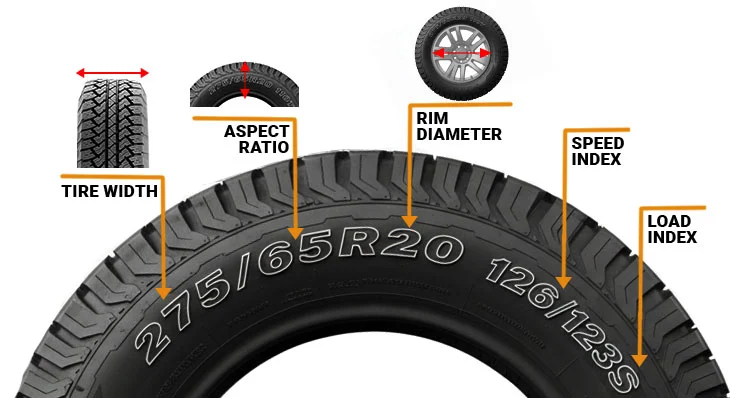
First and foremost, you have to understand that a 275/65R20 tire size is a combination of millimeters, inches, and percentages. Each number represents a specific tire measurement, so when these numbers are combined, they paint the whole picture, or so it seems. That said, let’s analyze each number and see exactly what they point towards.
- 275 – This is the width of the tire represented in millimeters. In other words, this tire in particular is 275 millimeters wide.
- 65 – This is the aspect ratio of the tire. It’s calculated as the height of the tire’s sidewall as a percentage of its width. In this example, the tire’s sidewall height is 65% of the tire’s width.
- R – This is actually a simple one. The letter indicates the tire’s construction type, which in this case is R, and it stands for radial construction.
- 20 – This number is straightforward and represents the wheel diameter in inches. So, the number 20 indicates that this tire is designed to fit onto a 20-inch wheel.
This might seem fairly complicated at first, but once you get the hang of it, you’ll be able to decode most of these numbers with relative ease. When you purchase tires in person, you can always ask a store clerk for assistance. However, when you shop for tires online, it’s best that you know what these numbers mean, so that you can make a more informed decision.
The “Equivalent” Comparison
In order to find an equivalent or at least a similar-sized tire to the 275/65R20 tire size, you’ll have to do a bit of math. This is probably not the desired outcome you were hoping for, but it’s necessary. Fortunately, there’s no need for complex mathematical equations; just a bit of calculus will do the trick. That said, let’s convert the numbers into inches to simplify things and make tire sizes easier to understand.
- First, let’s convert millimeters into inches to calculate the tire width. Since there are 25.4 millimeters in an inch, we will divide 275 by 25.4, which gives us approximately 10.8 inches.
- Second, we calculate the height of the tire using the aspect ratio. We have a 10.8-inch tire width, which we will multiply by 0.65, and we get 7 inches.
- Lastly, the wheel diameter is already expressed in inches, so we have a tire that’s 10.8 inches wide, has a 7-inch tall sidewall, and is fitted on a 20-inch wheel.
So, there you have it. A bit of calculations and know-how, and you’ll get the approximate measurements for your tires.
Now, when you look for an equivalent or something close to it, keep in mind that as long as there are slight variations in size, you won’t have to undergo any adjustments, alignments, or modifications to your wheels. Here are a couple of examples of what to look out for when you browse ideal tires for your vehicle.
- 295/60R20 – This size has a diameter of 33.9 inches, which is only a -0.40% difference from the original size. It is slightly wider than the 275/65R20.
- 270/65R20 – This option is slightly narrower and has a diameter of 33.8 inches, a -0.75% difference.
- 280/65R20 – This size is slightly wider and taller, with a diameter of 34.3 inches, which is a +0.75% variation.
Deep Dive: Performance Impacts
Most SUVs, trucks, and other heavy-duty vehicles can leverage different tire fitments. Of course, it’s always advisable to use sizes recommended by the vehicle and/or tire manufacturers.
However, upsizing or downsizing your tires and wheels isn’t necessarily bad, as long as you stay within 3% variation of the original tire diameter.
That said, changing the tire fitment can affect your vehicle’s overall performance for better or worse. For instance, tires that are larger or wider can increase rotating mass, potentially decreasing fuel economy by 1-2 mpg and slightly altering handling characteristics.
In addition, altering tire size will affect the speedometer ratings. In such cases, you’ll have to recalibrate the speedometer to ensure it measures speed and mileage accurately.
Practical Buying Guide
As mentioned before, the 275/65R20 tire size is common for SUVs, trucks, and other larger vehicles. Purchasing ideal tires in that or a similar size comes down to your needs and preferences.
The most important factor is what you’ll use those tires for. So, for instance, if you’re frequently driving through mud, then mud terrain tires are a better option than all terrain, since they specialize in a particular type of terrain.
As for the size, always check the recommended tire sizes for your vehicle and browse specific models and tire brands in accordance with those sizes. If you keep those factors in mind, you’ll always be able to opt for ideal tires that will ideally match your needs and expectations.
Final Thoughts
Although tire sizes are a blend of imperial and metric systems, figuring out what the numbers mean isn’t as difficult as it seems.
Thanks to some historical merger that later became an international standard, we’re stuck with cryptic numbers that need to be decoded, so we can figure out the exact dimensions of the tires we’re looking for.
But, as long as you make an effort to understand the numbers, you’ll be able to find the correct tire dimensions you need or a close equivalent that will get the job done.