What is a Vantablack Car? The Science, The Myth, and The BMW X6
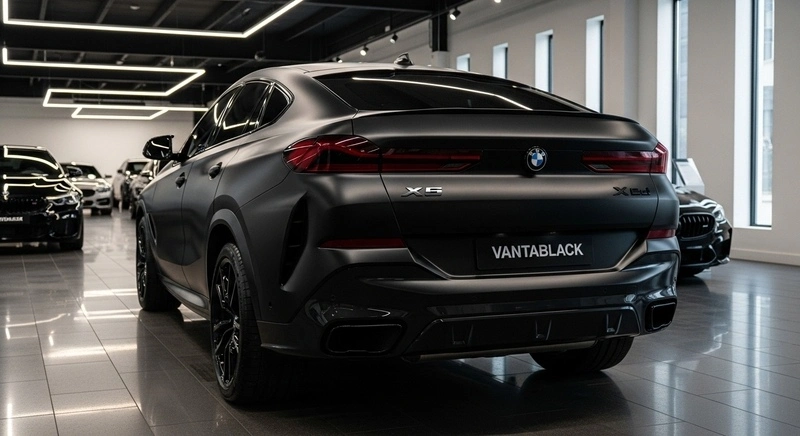
Imagine standing in front of a massive SUV, but your eyes can’t quite tell you what you’re looking at. You know it’s there. You can hear the engine humming. But the body of the car looks like a tear in the fabric of reality. It doesn’t reflect the sun. It doesn’t show shadows. It looks less like a vehicle and more like a void floating on wheels.
This isn’t a scene from a science fiction movie. This is the Vantablack BMW X6.
In 2019, the automotive world stopped in its tracks when BMW unveiled a one-off version of their X6 crossover coated in the “blackest black” ever created. The car quickly became a viral sensation, sparking a million questions. Is it real paint? Can I buy one? Is it legal to drive a portable black hole down the highway?
While the images are captivating, the reality behind the Vantablack car is a mix of high-end physics, clever engineering, and a bit of artistic stubbornness. It is a masterpiece of design, but as we will see, it is a vehicle that is scientifically impossible to put on the open road.
The Science Behind the Darkness: Understanding Vantablack
To understand why this car is so special, we have to look past the automotive industry and into the world of aerospace engineering. The word “Vantablack” isn’t just a cool marketing name; it is an acronym that stands for Vertically Aligned Nano Tube Array.
This material, developed by a British company called Surrey NanoSystems, is not a paint in the way we usually think of it. It doesn’t contain pigments or dyes. Instead, it is a “forest” of millions of carbon nanotubes.
Think of these nanotubes like incredibly tall, thin trees. They are so small that a single tube is about 3,500 times thinner than a human hair. When you pack billions of them together on a surface, strange things happen to light.
When a particle of light (a photon) hits a normal black car, some of it is absorbed, but a lot of it bounces back to your eye. That reflection is what tells your brain, “Here is the curve of the fender,” or “There is a scratch on the door.”
But when light hits Vantablack, it doesn’t bounce off. It gets trapped between those vertical tubes. The light bounces around endlessly within the forest of tubes until it eventually dissipates as heat. The result is an absorption rate of 99.965% of visible light.
When you look at it, your brain panics slightly. It expects to see depth and texture, but it receives zero visual data. The object loses its three-dimensional appearance and looks completely flat, like a silhouette cut out of black paper.
The World’s Only Vantablack Vehicle: The BMW X6
Car manufacturers are always looking for ways to grab headlines, but putting this sensitive aerospace material on a car was a massive risk. Surrey NanoSystems had actually turned down multiple requests from other automakers in the past. They didn’t believe the material would work well on a vehicle’s body.
However, when BMW approached them with the redesign of the X6, the team changed their minds. They felt the X6 had a unique, “expressive” design language that could actually handle the visual weight of the void.
The car made its debut at the 2019 Frankfurt Motor Show, and the reaction was immediate. In a hall filled with glossy, metallic supercars reflecting thousands of spotlights, the Vantablack X6 sat there absorbing everything. It was described as “anti-advertising.” Usually, car makers want you to see every line and curve they spent years designing. BMW did the opposite: they hid the car in plain sight.
Why VBx2? The Difference Between Paint and Nanostructures
There is a crucial detail that often gets lost in the hype. The BMW X6 was not coated in the original Vantablack formula.
If BMW had used the original “Vantablack S-VIS” material, the car would have been a disaster visually. The original formula is so dark that it would have completely erased the shape of the car. You wouldn’t be able to tell if the hood was curved or flat. The car would have looked like a formless blob.
To solve this, Surrey NanoSystems developed a specific variant called VBx2.
VBx2 is a sprayable coating that is slightly more forgiving than the raw nanotube arrays used on telescopes. While the original absorbs 99.965% of light, VBx2 allows for roughly 1% total hemispherical reflectance.
That tiny 1% makes all the difference. It provides just enough reflection for the human eye to perceive the “muscular” shape of the SUV. You can still see that it is a car, but it retains that unnerving, ghostly quality that made the project famous. It strikes a balance between scientific novelty and automotive design, allowing the viewer to appreciate the silhouette without losing the car entirely to the void.
Design Synergy: The Iconic Glow Kidney Grille
To stop the car from looking like a total phantom, Hussein Al Attar, the Creative Director of Automotive Design at BMW, had to play with light.
Since the body paint absorbed almost everything, the designers emphasized the parts of the car that emit light. This is where the Iconic Glow kidney grille came into play. The illuminated grille, along with the twin headlights and taillights, appear to float in space, unsupported by any visible bodywork.
This contrast created a stunning visual effect. It wasn’t just a black car; it was a study in extremes. The bright, sharp lights against the infinite darkness of the Vantablack body made the X6 look aggressive and dominant, earning it the nickname “The Beast” among fans.
Can You Buy a Vantablack Car? (Availability and Legality)
After seeing the photos, the first question most enthusiasts ask is, “Where do I sign?” Unfortunately, the answer is a hard no. You cannot order a Vantablack option from your local dealer, and you can’t buy the paint for a DIY project.
There are two main reasons for this: artistic rights and public safety.
First, the rights to use the original Vantablack pigment for creative arts are exclusively licensed to the British artist Anish Kapoor. This controversial deal means that no other artist or designer can use the material without his permission. The BMW collaboration was a rare exception negotiated specifically for the show car.
Second, driving a Vantablack car on a public road would be incredibly dangerous. Modern road safety relies on visibility. We need to see reflections to judge the distance and speed of other cars, especially at night. A car that absorbs light would essentially become invisible after sunset. You might see the floating headlights, but you wouldn’t see the car’s body until you crashed into it.
Furthermore, this paint would likely wreak havoc on autonomous driving systems. LiDAR (Light Detection and Ranging) sensors work by bouncing laser light off objects to map the road. Since Vantablack absorbs that light, a self-driving car might not even register that the BMW is there, treating it like a hole in the road rather than an obstacle.
The Practical Challenges of “The Blackest Black”
Even if you could legally drive it, owning a Vantablack car would be a logistical nightmare. The nanotube array is incredibly fragile.
The carbon nanotubes are not bonded like traditional automotive clear coat. They are delicate structures standing on end. If you were to touch the hood of the Vantablack X6, the oil from your finger would crush the tubes, leaving a permanent shiny spot. You cannot wash it. You cannot scrub it. Even driving it in the rain or through a dusty street would ruin the light-absorbing effect almost instantly.
This fragility makes the cost astronomical. While BMW never released an official price, the sheer difficulty of applying and maintaining the finish puts the estimated value of the project at over $300,000.
For most of us, vehicle customization is about durability, not just aesthetics. We want a finish that looks good but can also survive a trip to the grocery store. This is why, when considering a color change or restoration, most truck and car owners focus on standard automotive paints or bedliners. The investment is significant, but unlike Vantablack, it is practical. Many enthusiasts often wonder how much does it cost to paint a truck when looking for a durable, matte finish. While a quality paint job for a large vehicle is a serious financial commitment, it offers protection and style that won’t vanish the moment a bird flies overhead.
The Fate of the Vantablack X6: Where Is It Now?
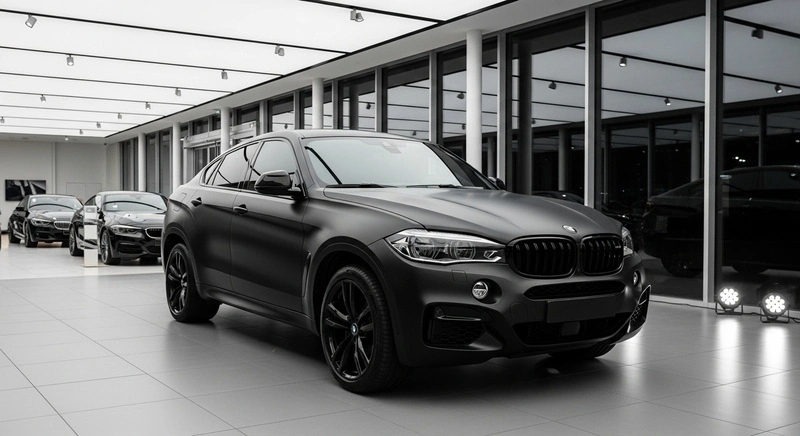
So, what happened to the specific X6 that stunned the world in Frankfurt?
You won’t find it parked at the BMW Welt or the museum in Munich. Because the VBx2 coating is so sensitive to environmental degradation, the car could not be displayed long-term. Dust and UV light would eventually degrade the blackness, turning the void into a dull, dark gray.
According to reports from BMWBLOG, the vehicle was retired and likely destroyed. It served its purpose as a concept. It proved that BMW could push the boundaries of design, but it was never meant to last. It was a fleeting moment of perfection that had to end before the real world ruined it.
Alternatives to Vantablack for Automotive Enthusiasts
Since you can’t have the real thing, the aftermarket world has responded with alternatives. Artists like Stuart Semple created paints like Black 3.0 and Black 4.0 specifically to challenge Vantablack’s exclusivity. Another popular option is Musou Black, an acrylic paint that absorbs about 99.4% of light.
You might have seen videos from channels like DipYourCar, where they sprayed a Mitsubishi Lancer in Musou Black. The result is undeniably cool and very close to the Vantablack look. However, the same rules apply: these paints are soft and brittle. They chip easily and can’t handle standard road abuse. They are fun for a YouTube video or a car show, but they aren’t a realistic option for a daily driver.
Conclusion: The Point of the Pointless Car
The Vantablack BMW X6 was never really about selling cars. It was about making a statement. It challenged our perception of what a vehicle should look like. In an industry obsessed with shiny chrome and metallic flakes, BMW dared to embrace the void.
It showed us that sometimes, the most powerful color is the absence of one. While we may never see a Vantablack car on the highway—and for safety’s sake, that’s probably a good thing—it remains one of the most fascinating experiments in automotive history.