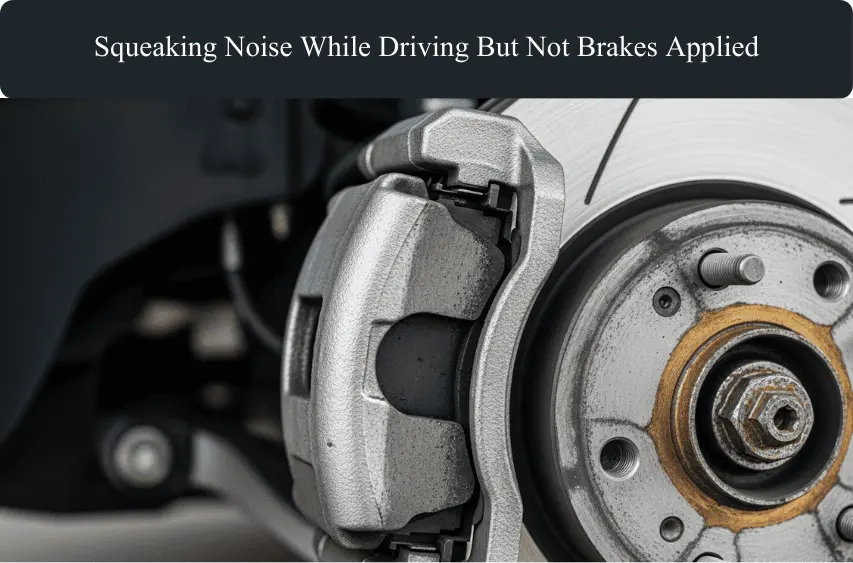
Squeaking Noise While Driving But Not Brakes Applied: Diagnostic Guide
There are few things more annoying than a high-pitched squeak that won’t go away. You press the brake pedal, expecting the noise to stop or change, but nothing happens. The squeak continues, rhythmically chirping as you drive down the road. It’s confusing because we naturally associate squealing noises with braking. When the noise persists without your foot on the pedal, it changes from a simple annoyance to a mechanical mystery.
This persistent sound is a distress signal. It indicates that two parts of your vehicle are rubbing together when they shouldn’t be. The causes can range from something as minor as a trapped pebble to something as critical as a failing wheel bearing or a seized caliper. Ignoring it often allows a cheap fix to turn into an expensive repair. This guide will help you isolate the noise, identify the culprit, and determine if your car is safe to drive.
The Mechanics of Non-Braking Squeaks
Before you start pulling wheels off, it helps to understand the physics of the sound. A squeak that occurs while you are just driving—coasting or accelerating—usually falls into one of two categories: rotational or suspension-based.
Rotational noises speed up and slow down with your car. If the “chirp-chirp-chirp” gets faster as you accelerate, the issue is likely attached to your wheels, brakes, or driveshaft. Suspension noises, on the other hand, react to the road. If the squeak happens only when you hit a bump or dip, the issue lies in the springs, struts, or bushings that absorb road impact.
Regardless of the source, the root cause is almost always dry friction. Metal is rubbing against metal, or rubber is rubbing against steel, without enough lubrication.
Brake-Related Culprits (That Squeak Without Braking)
Ironically, the braking system is still the most common source of these noises, even if you aren’t using the brakes. Your brake pads sit mere millimeters away from the spinning rotor. If anything disturbs this tiny gap, you will hear about it.
The Brake Wear Indicator
Car manufacturers design brake pads to tell you when they are dying. They do this with a simple device called a wear indicator—a small metal tab attached to the brake pad. When the pad material wears down to a dangerous level (usually 2-3mm), this metal tab begins to scrape against the rotor.
This design is intentional. The tab is positioned so that it hits the rotor before the brake pad backing plate does. It creates a high-pitched squeal or chirp while the wheels are turning. Surprisingly, this noise often disappears when you actually press the brake pedal because the pressure forces the tab firmly against the rotor, stopping the vibration. If you hear this sound, your car is begging for maintenance.
Stuck Brake Calipers and Guide Pins
Your brake calipers are the hydraulic clamps that squeeze the pads against the rotor. These calipers slide on metal guide pins to ensure even pressure. However, these pins live in a harsh environment of heat, road grit, and moisture. If the protective rubber boot fails, the grease inside dries up, and the pins can seize.
When a guide pin gets stuck, the caliper cannot fully release the brake pad after you lift your foot off the pedal. The pad continues to lightly drag against the spinning rotor. This constant, light contact creates a rhythmic squeak and generates excessive heat. You might notice that one wheel is significantly hotter than the others after a drive, or that the car pulls slightly to one side.
Glazed Rotors and Uneven Surfaces
Brake rotors are supposed to have a specific surface texture to mate with the pads. However, excessive heat from riding the brakes or a seized caliper can “glaze” the rotors. This means the friction material crystallizes onto the metal, creating a hard, mirror-like finish.
This slick surface can cause high-frequency vibrations that result in a continuous squeal. This is common if new pads were installed on old rotors without resurfacing them. If you have recently had service done and the noise persists, it could be an issue with bedding-in procedures or part quality. You might be dealing with brakes squeaking after new pads, which often points to hardware that hasn’t settled correctly.
Debris: The “Stuck Stone” Phenomenon
Sometimes, the problem isn’t a failed part but a foreign invader. Your braking system includes a thin metal plate called a dust shield, which sits behind the rotor. It doesn’t take much for a piece of gravel or road debris to get kicked up and trapped in the narrow space between the shield and the rotor.
The sound of a stuck stone is distinct and terrifying. It is usually a loud, continuous metal-on-metal screech that sounds like your car is being torn apart. While it sounds catastrophic, the fix is often as simple as locating the stone and popping it out with a screwdriver.
Suspension and Steering System Issues
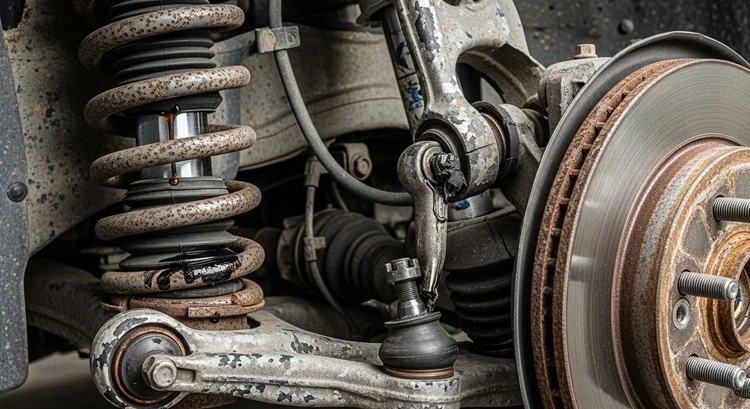
If the squeak doesn’t speed up with your car but rather complains when you hit a bump or turn a corner, you are likely dealing with suspension issues. Your car’s suspension is a complex network of links, arms, and joints designed to absorb the road. When the lubrication fails, the noise begins.
Worn Suspension Bushings
Your suspension arms connect to the frame of the car using rubber bushings. These act as cushions, allowing metal parts to twist and flex without grinding against each other. Over time, rubber dries out, cracks, and shrinks.
When a bushing goes bad, the metal sleeve inside it starts to rub directly against the frame or the control arm itself. This creates a distinct “creaking” or “squeaking” sound, similar to an old mattress. You will hear this most often when going over speed bumps or entering a steep driveway. Silicone spray can sometimes quiet them temporarily, but the only real fix is replacement.
Dry or Damaged Ball Joints
Ball joints are exactly what they sound like: a metal ball inside a socket that acts as a pivot point for your wheels. They allow your suspension to move up and down while also letting you steer left and right. These joints are packed with grease and sealed with a rubber boot.
If that boot tears, water gets in and grease gets out. The result is a dry, rusting metal ball grinding inside a metal socket. A bad ball joint will squeak loudly when you turn the steering wheel at low speeds, like when parking. It may also clunk or pop as the joint gets looser. This is a safety-critical part; if it snaps, your wheel can collapse.
Tie Rod Ends and Steering Couplings
Similar to ball joints, tie rod ends connect your steering rack to your wheels. They also use a ball-in-socket design that relies on grease. When they wear out, you will hear a high-pitched squeak every time you turn the wheel, even if the car is sitting still. If the noise seems to come from right behind your steering wheel (inside the cabin), it could be the steering column coupling or “clock spring” needing lubrication.
Drivetrain and Rotational Components
Sometimes the noise is rhythmic like a brake issue, but deeper and more consistent. This points to the parts that actually turn the wheels.
Failing Wheel Bearings
Wheel bearings are the precision steel balls that allow your wheels to spin freely with minimal friction. They are sealed units, but seals eventually fail. When moisture enters a bearing, it creates pits and rust on the smooth steel surfaces.
A bad wheel bearing usually starts with a faint chirp or squeak that matches your speed. As it gets worse, it turns into a growl or a humming noise. A classic sign is that the noise changes when you shift the car’s weight. If you swerve slightly to the left and the noise stops, it means the bad bearing is on the left (because you took the weight off it).
In modern cars, these mechanical failures can have digital consequences. A wobbling wheel bearing can confuse wheel speed sensors, triggering dashboard warnings. You might see alerts stating that Mercedes Active Brake Assist functions are limited, indicating that physical wear is disrupting the delicate electronic safety systems.
Universal Joints (U-Joints) and CV Joints
If you drive a rear-wheel-drive truck or SUV, you have a driveshaft running underneath the vehicle. This shaft uses Universal Joints (U-Joints) to flex as the suspension moves. When the grease inside a U-joint dries up, it produces a rhythmic, metallic squeak that speeds up as you accelerate. It sounds like an angry bird chirping under your floorboards.
For front-wheel-drive cars, the equivalent is the CV (Constant Velocity) joint. While these usually “click” when they fail, a dry CV boot can also squeak as the axle rotates.
Under the Hood: Engine and Belt Squeals
Sometimes the squeak isn’t coming from under the car, but from the front of it. If the noise rises and falls with your engine RPM—even when the car is stopped in neutral—pop the hood.
The Serpentine Belt and Tensioner
The serpentine belt powers your alternator, power steering, and air conditioning. It is made of rubber and reinforced cord. As it ages, it glazes over and loses its grip.
A loose or glazed belt will slip on the pulleys, creating that classic, ear-piercing squeal that wakes up the neighbors. This often happens on cold mornings or when you turn the A/C on. The culprit isn’t always the belt itself; often, the automatic tensioner (a spring-loaded pulley) gets weak and can no longer hold the belt tight.
Alternator and Idler Pulleys
The belt spins around several metal pulleys. Each of these pulleys has a bearing inside. If the bearing in your alternator or idler pulley seizes, it will scream. A quick way to test this is to spray a tiny amount of water on the belt while it’s squeaking. If the noise stops instantly, it’s the belt. If the noise continues unchanged, it’s likely a bad pulley bearing.
Tire and Wheel Factors
Your tires are the only part of the car that touches the ground. If they aren’t rolling perfectly, they will let you know.
Uneven Tire Wear and Alignment
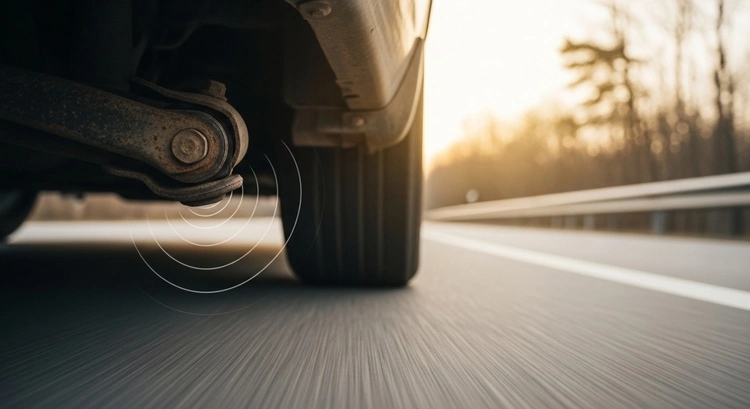
When your wheels are out of alignment, the tires don’t roll straight; they drag slightly across the pavement. This constant scuffing creates a wear pattern known as “feathering” or “cupping.”
Cupped tires have high and low spots on the tread blocks. As these uneven blocks hit the road at speed, they create a rhythmic noise. While usually described as a growl or a “wub-wub-wub” sound, on polished concrete or specific asphalt types, this friction can manifest as a high-pitched squeak.
Loose Lugs or Wheel Trim
Sometimes the solution is embarrassingly simple. A loose hubcap or wheel cover can vibrate against the steel rim, creating a plastic-on-metal chirp that sounds terrifyingly expensive but costs nothing to fix. Similarly, if a lug nut has backed off slightly, the wheel may shift against the hub, causing a metallic clicking or squeaking sound that speeds up with the car.
Diagnostic Guide: How to Isolate the Noise
You don’t need a degree in mechanical engineering to narrow down the problem. Find a safe, empty parking lot and perform these four simple tests.
The “Bounce” Test
Park the car and turn off the engine. Go to each corner of the vehicle and push down hard on the fender, bouncing the suspension up and down.
- If you hear a squeak: You have a suspension issue. It’s likely a dry bushing, strut mount, or ball joint.
- If it’s silent: Your suspension is likely fine, and the noise is rotational (brakes or bearings).
The “Swerve” Test
Drive safely at a moderate speed (around 30-40 mph) on an empty road. Gently swerve the car left and right to shift the weight.
- If the noise gets louder when turning LEFT: The weight is on the right side, so your right wheel bearing is likely bad.
- If the noise gets louder when turning RIGHT: The weight is on the left side, so your left wheel bearing is likely bad.
- If the noise doesn’t change: It is likely a brake or belt issue.
The “Rev” Test
With the car parked in “Park” or “Neutral,” rev the engine slightly.
- If the squeak speeds up with the engine: It is a belt or pulley issue under the hood.
- If the squeak stays silent: The issue is in the wheels or drivetrain (because they aren’t moving).
The “Light Braking” Test
Drive at a steady speed where the squeak is audible. Lightly tap the brake pedal with your left foot while keeping your right foot on the gas.
- If the squeak stops immediately: It is a brake hardware issue. The caliper is dragging, or the wear indicator is vibrating.
- If the squeak continues unchanged: It is likely a wheel bearing or suspension issue, as these are not affected by brake pressure.
Fixes and Solutions
Once you’ve identified the source, the fix is straightforward:
- Lubrication: For suspension squeaks, silicone spray on rubber bushings can offer temporary relief. However, greaseable ball joints and tie rods will need a grease gun to repack them with fresh lubricant.
- Cleaning: If the issue is debris, removing the wheel and pressure-washing the brake assembly often dislodges trapped stones.
- Replacement: There is no “repairing” a bad wheel bearing, a glazed belt, or a worn-out brake pad. These constitute wear items and must be replaced to restore safety.
FAQs
It depends on the source. If it is a trapped stone or a squeaky bushing, it is annoying but safe. If it is a failing wheel bearing or a ball joint, it is dangerous. These parts hold your wheel on. If they fail completely, you lose control of the vehicle.
This is the classic sign of a brake hardware issue. When you press the pedal, the hydraulic pressure clamps the pads tight against the rotor. This clamping force stops the vibration of the wear indicator or realigns a loose pad, temporarily silencing the noise.
Serpentine Belts: $100 – $200
Brake Pads/Rotors: $300 – $600 per axle
Wheel Bearings: $250 – $500 per wheel
Suspension Bushings: $150 – $400 (mostly labor)
The Bottom Line
A squeaking noise while driving is your car’s way of talking to you. It is telling you that friction is occurring where it shouldn’t. While it might be tempting to turn up the radio and ignore it, the noise will eventually turn into a grind, a clunk, or a breakdown.
Start with the simple checks: look for trapped stones, check your belts, and listen to when the sound happens. Whether it’s a $20 belt or a $300 wheel bearing, fixing it early is always cheaper than calling a tow truck later.