BMW VANOS Repair Explained: Causes, Symptoms, and Repair Options
The VANOS system controls camshaft timing through hydraulic adjustment for BMW engines. BMW vanos repair solutions address a common issue that occurs caused by deteriorating internal seals and reduced hydraulic performance. The VANOS system controls valve timing and the distribution of engine torque. It also helps maintain idle stability and manage emissions. The engine output starts to deviate from its factory settings when the system fails to keep the specified camshaft positions. This deviation is not abstract or subjective. It can be measured through pressure loss, timing delay, and reduced adjustment range.
How the BMW VANOS System Works
VANOS adjusts camshaft phase angle relative to the crankshaft using pressurized engine oil. Oil pressure acts on a piston housed within the VANOS unit. The engine control unit activates solenoids that direct oil to specific chambers, moving the piston forward or backward. Piston movement rotates the camshaft through a helical spline interface.
Single VANOS systems control intake cam timing. Double VANOS systems control both intake and exhaust cams independently. Engine performance improves when cam timing is advanced, as this enhances cylinder filling and combustion efficiency. The system also improves airflow at high RPMs, optimizing performance across the engine’s operating range. The system needs stable oil pressure, together with controlled leakage and accurate clearance measurements, to achieve correct performance. Camshaft positioning issues occur when oil leaks past the piston, preventing proper movement.
Common Causes of VANOS Failure
VANOS failures typically result from material degradation rather than random causes. The dominant failure mechanism is degradation of elastomer seals inside the piston assembly. These seals are continuously exposed to high temperature, oil additives, and pressure cycling. Once this occurs, oil leaks internally between pressure chambers.
Internal leakage prevents the piston from reaching commanded positions. The control unit continues to request timing changes, but the mechanical response becomes slower and less accurate. Reduced effective oil pressure at the VANOS unit compounds the issue. Oil contamination from extended service intervals can restrict flow and further reduce system response. Structural damage to pistons or housings is rare and typically linked to severe oil starvation, not normal wear.
Symptoms of a Failing VANOS System
VANOS degradation produces consistent operational symptoms tied directly to incorrect valve timing. These symptoms develop gradually and vary with temperature and engine load. Typical indicators:
- Rough or unstable idle due to incorrect valve overlap.
- Reduced low-speed torque caused by delayed intake cam advance.
- Inconsistent mid-range acceleration from incomplete cam adjustment.
- Metallic rattling or ticking noise near the timing cover at specific RPM ranges.
- Diagnostic fault codes indicating camshaft timing deviation or slow VANOS response.
The engine often remains drivable, which leads to delayed diagnosis. Symptoms are often incorrectly attributed to ignition coils, fuel injectors, or timing chain components.
VANOS Repair Kits and What They Include
VANOS repair kits are engineered to restore hydraulic sealing efficiency. They address components that fail due to material aging rather than mechanical overload. The core elements of a repair kit are upgraded piston seals manufactured from high-temperature, oil-resistant elastomers. These materials maintain elasticity under prolonged thermal stress and resist compression set. Additional O-rings are supplied for internal oil passages where applicable.
Some kits include anti-rattle components designed to control axial movement in VANOS designs known to produce mechanical noise. These components do not change timing behavior. Their purpose is to stabilize internal clearances once hydraulic control is restored.
Repair kits do not include gears, pistons, or housings because these parts rarely fail in isolation. The objective is pressure restoration, not redesign.
Repair Options: Rebuild vs. Replacement
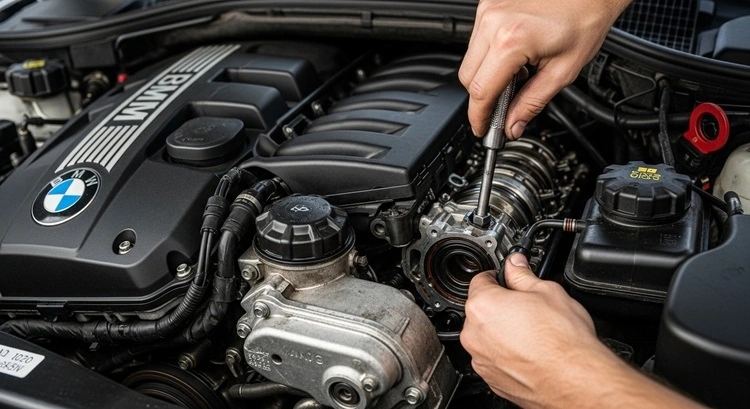
There are two viable technical approaches to resolving VANOS-related faults. The first is rebuilding the existing unit. This involves removing the VANOS assembly, disassembling it, replacing internal seals, and reinstalling it using original mechanical components. When sealing failure is the root cause, rebuilding restores oil pressure retention, piston response, and camshaft positioning accuracy. Engine calibration remains unchanged, and original tolerances are preserved.
The second approach is complete VANOS unit replacement. Replacement is needed only from physical damage to the piston bore, spline interface, or housing.
The BMW VANOS system is a hydraulic control mechanism dependent on internal sealing integrity. Seal leakage reduces camshaft control precision, affecting torque delivery, idle quality, and throttle response. The VANOS repair kits fix the main problem by restoring hydraulic efficiency, which lets the system function properly without needing to replace working parts.