How Automation is Supporting (Not Replacing) Skilled Technicians
Automation has long brought productivity increases and worries about job displacement. From the spinning jenny at the onset of the Industrial Revolution to artificial intelligence (AI) today, there’s no shortage of debate over whether the positives will outweigh the negatives. There are even disputes over just what the positives and negatives are.
Narrowing the scope to auto repair, what does automation in the 2020s and the future mean for the industry? Will we see a reduction in the number of collision repair technicians? Will we see quicker, more efficient, and more accurate auto body repairs? Let’s look at automation and collision repair.
Putting the “auto” in “auto repair.”
You may already know that “auto” means self, as in “autobiography.” Well, the prefix in “automobile” means the same thing. The word combines Greek and Latin prefixes, with “auto” being Greek and “mobile” coming from the Latin for “movable.” In short, your car moves by itself.
Of course, it doesn’t; you still must press the gas pedal. (Let’s not get into self-driving cars here.) But the vehicle then takes over and moves you without the use of your feet or even a horse. Given that the industry has its origins in automation, it should be no surprise that advances in tech have only furthered automation in both manufacturing and collision repair.
In the past, this meant an overall reduction in jobs, at least when it comes to making vehicles. Thus, it’s natural that auto repair technicians worry about their own job security. And it makes sense that drivers are concerned about auto body repair shops rushing automation to use to lower costs, resulting in poorer job quality. But the truth is, the best collision repair shops use automation to support, not replace, skilled repair technicians.
Automation in collision repair
Automation is a broad term that can cover a lot of ground. Everything from a robotic arm in a manufacturing plant to predictive text in an emailed invoice falls under the automation umbrella. For auto body repair, technicians and shop owners regularly use automation in the following ways:
AI-assisted vehicle diagnostics
At the dawn of the automotive age, many people thought of vehicles as “horseless carriages.” Today, it’s more accurate to think of them as “computers on wheels.” Modern vehicles generate enormous amounts of data every time they’re driven. When a warning light turns on, auto repair technicians don’t just read a single code; they interpret sensor readings, historical data, and manufacturer specifications.
AI-assisted diagnostic tools help organize and analyze that information quickly, highlighting the most likely causes of a problem. The technician still confirms the issue and decides on the repair, but automation reduces guesswork. The result is faster troubleshooting, fewer unnecessary part replacements, and more accurate repairs the first time around.
Computer vision for damage measurement
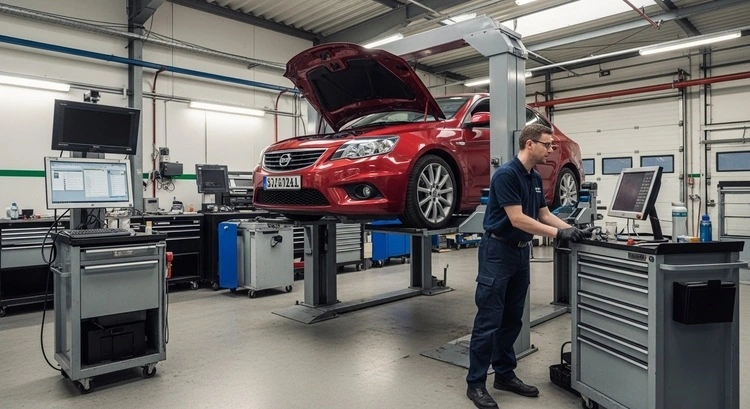
Similar to diagnostics, automation can play a huge role in the damage measurement phase of auto repair. With sophisticated damage assessment tools, repair technicians can photograph a vehicle with a special diagnostic camera that interfaces with software that reconstructs a 3D model. The program then identifies issues such as gaps between the vehicle panels, the severity of impacts, and surface damage.
Such tools improve both accuracy and documentation for estimates. Furthermore, repair technicians can use these tools to check wheel alignment in real time. This process is faster and more precise than manual alignment checks.
Automated ADAS calibration
Advanced driver automation systems, or ADAS, are pretty much standard on vehicles now. These include well-established and widespread technologies, such as anti-lock brakes, as well as rarer, more sci-fi features, such as projecting vehicle information right onto a smart windshield.
Most ADAS have sensors that require precise calibration. Unfortunately, it’s easy for a collision repair to mis-calibrate these sensors, even if the auto repair doesn’t directly relate to any ADAS feature. Thankfully, auto repair technicians can use automated calibration rigs to align sensors using robotics combined with software guidance. These tools make complex calibrations faster and remove human guesswork.
Smart paint and colour-matching systems
While it may seem like one of the simpler forms of auto repair, vehicle painting can be quite tricky; matching modern automotive paint is more complicated than it looks. Today’s finishes often contain metallic flakes, pearl layers, and multi-stage coatings that can vary slightly even between vehicles of the same model year.
Smart colour-matching systems use digital spectrophotometers to scan the vehicle’s paint and compare it to manufacturer databases. The software recommends an exact formula, and automated mixing systems measure the tint precisely. Repair technicians still prepare and apply the paint, but automation improves consistency, helping ensure the repaired panel blends seamlessly with the rest of the vehicle.
Predictive maintenance tools
As Benjamin Franklin once wrote, “An ounce of prevention is worth a pound of cure.” It’s true in medicine and in vehicle maintenance. The best auto body repair shops know this and help prepare their customers and their own repair technicians.
It’s possible to use AI to analyze patterns over time to predict part failures before they happen. AI can help establish specific, proactive maintenance for issues surrounding:
- Battery life predictions.
- Brake wear forecasting.
- Transmission issue alerts.
Partnership, not competition
When an auto repair business hires another staff member, it would be silly for the repair technicians who work there to see the new hire as competition. Similarly, when an auto body shop incorporates a new automated technology, it’s there to work with the technicians, not to replace them.
It’s impossible to say what automation technologies, such as AI, might mean for the long-term future. But right now, and at least for the foreseeable future, there’s little reason to think skilled repair technicians are being replaced. The best auto repair businesses let automation do what it does best—handle repetition and data processing.
Meanwhile, auto body technicians can keep doing what they do best: provide judgment, experience, and accountability.