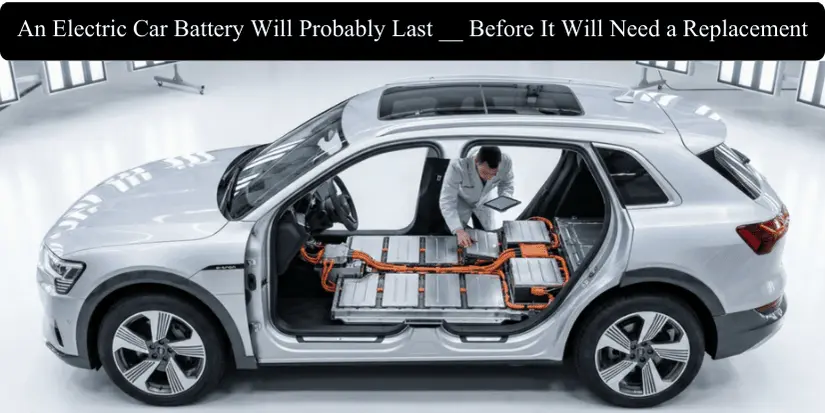
An Electric Car Battery Will Probably Last ____________ Before It Will Need a Replacement.
If you are thinking about making the switch to electric, you have likely paused to fill in that blank with a number that makes you nervous. You aren’t alone. For decades, drivers have measured a car’s life by its engine—how many miles until the head gasket blows or the transmission slips? But with electric vehicles (EVs), the anxiety shifts to a single, expensive component: the battery.
The short answer? An electric car battery will probably last 10 to 20 years before it needs a replacement. In terms of distance, that is often between 100,000 and 200,000 miles.
For most drivers, this means the battery will actually outlive the car itself. While your phone battery might give up the ghost after three years, the sophisticated lithium-ion pack in a modern EV is built for the long haul. It isn’t just about raw endurance, though; it is about how manufacturers engineer these packs to handle daily abuse, extreme weather, and highway speeds without failing.
The Reality of EV Battery Lifespan: Warranties vs. Data
There is often a wide gap between what automakers guarantee and what actually happens on the road. When you buy a gas truck, you might worry about mechanical failures—like when Ford recalls hundreds of thousands of Maverick pickup trucks due to safety or performance issues. With EVs, the fear is silent degradation. Fortunately, the data suggests that catastrophic battery failure is far rarer than the average mechanical recall.
Manufacturer Warranties and Standards
Almost every major automaker, from Tesla to Nissan and Volkswagen, offers a warranty that reflects their confidence in the technology. The industry standard currently sits at 8 years or 100,000 miles.
This warranty doesn’t just cover total failure; it covers capacity retention. Most brands guarantee that your battery will hold at least 70% of its original capacity during that period. If it drops below that threshold, they replace it. This creates a safety net that covers the average ownership period of a vehicle two times over.
What Real-World Data Tells Us
Warranties are promises, but data is proof. Recent studies from telematics companies like GEOTAB and research groups like Recurrent have analyzed thousands of vehicles to see how they hold up in the wild.
The findings are surprisingly positive. One extensive study of 15,000 electric cars found that only 1.5% of batteries have ever been replaced. Most of those replacements weren’t due to old age or natural wear, but rather manufacturing defects that popped up early in the car’s life—exactly the kind of thing warranties are designed to catch.
Furthermore, we are seeing “million-mile battery” technology moving from the lab to the production line. While the average driver won’t need that kind of longevity, it proves that the chemistry is becoming robust enough to rival, and eventually exceed, the lifespan of commercial diesel engines.
Understanding the Tech: How Do EV Batteries Degrade?
To understand why these batteries last so long, you have to look inside the cell. It isn’t magic; it’s chemistry. And like all chemistry, it changes over time.
The Basics of Lithium-Ion Chemistry
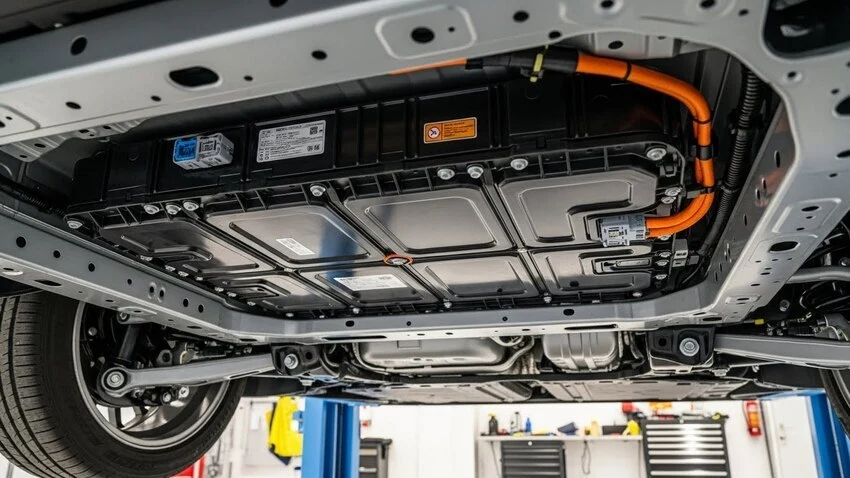
Most modern EVs use lithium-ion batteries, similar to what is in your laptop but scaled up and managed much more aggressively. These batteries work by moving ions between a cathode and an anode. When you charge, ions move one way; when you drive, they move back.
Over the years, two types of aging occur:
- Calendar Aging: This happens even if the car is parked. The chemicals inside slowly degrade just by existing, especially if the battery is sitting at 100% charge in a hot garage.
- Cyclic Aging: This is wear and tear from use. Every time you charge and discharge, physical stress is placed on the battery’s internal structure.
However, unlike a gas engine that has thousands of moving parts rubbing against each other, a battery has no moving parts. This is why maintenance is so different. You stop worrying about how much is an oil change at Valvoline and start thinking about software updates and charging habits.
The Non-Linear Nature of Degradation
A common misconception is that battery health drops in a straight line—100% today, 90% next year, 80% the year after. Real-world degradation is actually non-linear.
Typically, a new EV battery will lose a small percentage of its capacity (perhaps 2-3%) within the first year as the chemistry “settles.” After this initial drop, the degradation curve flattens out significantly. A well-managed battery might then sit at 90-95% health for many years, losing capacity very slowly until it reaches the very end of its life cycle.
Critical Factors That Influence Battery Longevity
While the baseline lifespan is excellent, how you treat the car determines if it lasts 10 years or 20. External factors play a massive role in chemical stability.
The Impact of Temperature and Climate
If batteries had an arch-nemesis, it would be heat. High temperatures accelerate the chemical reactions inside the cell, causing it to degrade faster than normal. This is why early EVs with air-cooled batteries (like older Nissan Leafs) struggled in hot climates like Arizona.
Modern EVs use liquid cooling systems. These systems circulate coolant through the battery pack to keep it at an optimal temperature, regardless of whether you are driving in a blizzard or a heatwave. This thermal management is the single biggest reason why modern batteries are lasting longer than their predecessors.
Charging Habits and Depth of Discharge (DoD)
Temperature isn’t the only thing that stresses a battery out; how you feed it energy matters just as much. You might love the convenience of a Supercharger or a DC Fast Charger that gets you back on the road in 20 minutes, but your battery has mixed feelings about it.
Fast charging pushes a massive amount of current into the cells very quickly. This generates internal heat, and as we discussed, heat is the enemy. Occasional fast charging for road trips is perfectly fine, but relying on it for your daily commute can shave years off the battery’s optimal health.
Then there is the concept of “Depth of Discharge” (DoD). Think of your battery like a rubber band. If you stretch it to its absolute limit (100%) and then let it go all the way slack (0%) over and over again, it eventually loses its snap. The same applies to lithium-ion cells. Constantly draining the battery to empty and filling it to the brim puts mechanical stress on the materials inside.
Driving Style and Load
Your right foot also plays a role. Aggressive driving demands sudden bursts of high power, which forces the battery to discharge rapidly. This creates hotspots within the pack. Conversely, smooth driving not only extends your range for the day but helps the battery last for the decade.
This is where electric cars have a secret weapon: regenerative braking. When you lift off the accelerator, the motor acts as a generator, sending energy back into the battery. This process is generally much gentler than a plug-in charge and helps maintain a healthy state of charge while you drive, reducing the overall workload on the cells.
EV vs. ICE: A Durability Comparison
When we compare electric vehicles to their Internal Combustion Engine (ICE) counterparts, the difference in durability is stark. A traditional engine contains roughly 2,000 moving parts—pistons, valves, crankshafts, and gears—all grinding against each other at high temperatures. It is a miracle of engineering, but it is also a ticking clock of mechanical wear.
In contrast, an EV powertrain has about 20 moving parts. The electric motor is incredibly simple and robust. The battery, while complex chemically, has no moving parts to break.
- ICE Vehicles: typically last 12–15 years or about 150,000 miles before major components like the transmission or engine block fail.
- Electric Vehicles: are projecting lifespans of 15–20 years, with batteries capable of hitting 300,000 miles or more.
While you might spend money replacing a battery module in year 15, you likely won’t have spent a dime on timing belts, spark plugs, or transmission fluid changes in the meantime.
Signs That a Battery Needs Replacement
Even with the best care, batteries do age. But unlike a gas car that might leave you stranded with a blown radiator, an EV battery rarely fails suddenly. It is a slow, predictable fade.
Here is what to look for:
- Reduced Range: This is the most obvious sign. If your 300-mile range is now consistently topping out at 200 miles, the capacity has degraded.
- Slower Charging: If the battery takes significantly longer to reach 80% than it used to, internal resistance has likely increased.
- Phantom Drain: If you park your car with 50% charge and come back the next day to find it at 40%, the cells are struggling to hold energy.
- Dashboard Alerts: The car’s Battery Management System (BMS) is smart. It will trigger a warning light if it detects a specific cell module is out of balance or failing.
Best Practices to Extend Your Battery’s Lifespan
If you want to be on the high end of that 20-year estimate, a few simple habits make a massive difference.
- Follow the 20-80% Rule: Try to keep your state of charge between 20% and 80% for daily driving. Only charge to 100% when you are planning a long trip.
- Minimize Rapid Charging: Treat Level 3 fast charging as a travel necessity, not a daily routine. Stick to Level 2 home or work charging whenever possible.
- Preconditioning: If your car is plugged in, use the app to warm up or cool down the cabin before you disconnect. This uses grid power rather than battery power to regulate the temperature, saving the battery for the drive.
- Smart Storage: If you are going on a month-long vacation, don’t leave the car at 100% or 0%. Leave it at roughly 50% in a cool place (like a garage) to minimize chemical stress.
The Lifecycle: Second Life and Recycling
One of the most exciting aspects of EV technology is what happens after the car retires. When a battery “fails” in a car, it usually still holds about 70% of its capacity. It might be too weak to accelerate a two-ton vehicle up a highway on-ramp, but it is still incredibly powerful.
Repurposing for Energy Storage
These “retired” batteries are finding a second life in stationary storage. They are being stacked in warehouses to store solar energy during the day and release it into the grid at night. In this role, a battery that drove 150,000 miles could serve another 10 to 15 years stabilizing the power grid.
Closing the Loop: Recycling and Raw Materials
Eventually, when the battery is truly spent, it doesn’t end up in a landfill. Companies are now deploying closed-loop recycling systems. They can shred the battery and recover up to 95% of the critical materials—Lithium, Cobalt, Nickel, and Copper. These materials are then refined and put directly back into the production of brand-new batteries. This reduces the need for mining and lowers the carbon footprint of every new EV built.
The Future of Electric Car Batteries
We are currently in the early stages of battery evolution. Engineers are working on Solid-State Batteries, which replace the liquid electrolyte with a solid material. These promise to be safer, charge faster, and last significantly longer than current lithium-ion cells.
As mass production ramps up, costs are plummeting. The “battery replacement” cost that scares so many buyers today will likely be a fraction of the price by the time your new EV actually needs one—if it ever does.
Conclusion
So, how long will an electric car battery last? Long enough that you probably won’t be the one to replace it.
With an average lifespan of 10 to 20 years and the ability to cover hundreds of thousands of miles, the battery is arguably the most durable part of the modern car. By avoiding extreme heat and practicing smart charging habits, you can ensure your EV remains a reliable daily driver for decades. The technology is built to go the distance, and the data proves it is doing just that.